


Contemporary Ceramics gallery and shop exhibits the greatest collectable names in British ceramics along with the most up and coming artists of today. Our distinguished makers are all carefully selected members of the Craft Potters Association.
All of our makers are members of the Craft Potters Association and each of them have a story to tell.
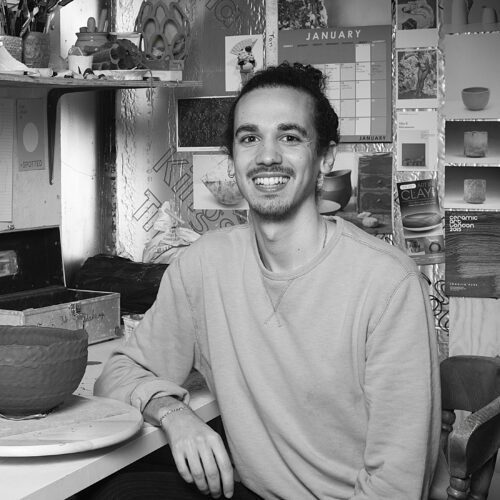
Toni’s work and ethos is centred around the idea of ceramics and its strong association with craft – as a material and its context within the fine art spectrum. He is interested in the history and connotations of porcelain and terracotta. The materials as symbols of trade, status, function, hierarchy; all are factors which correlate with the constant debate regarding crafts and its position within today’s society.

Martin describes his work as ‘ Clay – Water – Wood – Fire – Space’. These five elements are synthesised to create a reversed trompe-l’œil type of work, seemingly excavated or revealed, and simultaneously diminishing the third dimension.

As a rebellious schoolgirl, Tina always knew that she would go to art college as she absented herself from her maths lessons to go to exhibitions. In 1974, she commenced her BA in Ceramics at Bristol Polytechnic with a strong 2D portfolio but hardly any experience of working with clay and she found it challenging. Nevertheless, she was drawn to it because it was the only material which was so malleable, human, primal, intimate, flexible, fundamental, and could be adapted to suit all personalities.

Clare Conrad's work is an exploration of colour and texture, inspired by the effects of light and ageing on architecture, artefacts and landscape. Her technique of layering vitreous slip onto wheel-thrown vessels, vases and bowls creates a rugged texture.

Katharina was experimenting with clay as soon as she could reach the pedals on her mother's wheel. Since setting up her business in Cambridge in 2016, Katharina's work has received many accolades, including receiving the Silver Award (Ceramics) in the Craft&Design Selected Maker Awards.

Terry was born in Abergele in North Wales and is a graduate of the seminal Harrow Ceramics course, where he was taught by Victor Margie and Mick Casson. He worked with Denise and Rosemary Wren in Surrey before returning to North Wales in 1978 where he set up a studio with his wife Bev Bell-Hughes in Llandudno Junction.
His work is primarily in thrown, high-fired domestic pots, reflecting influences from both Oriental and British country ware.