

Deliveries to European Union countries are currently suspended due to new EU regulations.
Contemporary Ceramics gallery and shop exhibits the greatest collectable names in British ceramics along with the most up and coming artists of today. Our distinguished makers are all carefully selected members of the Craft Potters Association.
All of our makers are members of the Craft Potters Association and each of them have a story to tell.

Jane is a self-taught ceramicist and began coiling and smoke firing over 30 years ago. She worked for many years as a lecturer in art specialising in ceramics and finds inspiration in neolithic landscapes and artefact. Living on the Somerset/ Wiltshire border provides rich source material. The meditative simplicity of coiling is a fundamental part of her practice. Jane is fascinated by the universality of clay and how it lies at the heart of the human experience. She travelled widely in Africa researching the spiritual use of clay and visiting remote pottery communities, running workshops in the Namibia and Kalahari deserts with funding from the British Council.

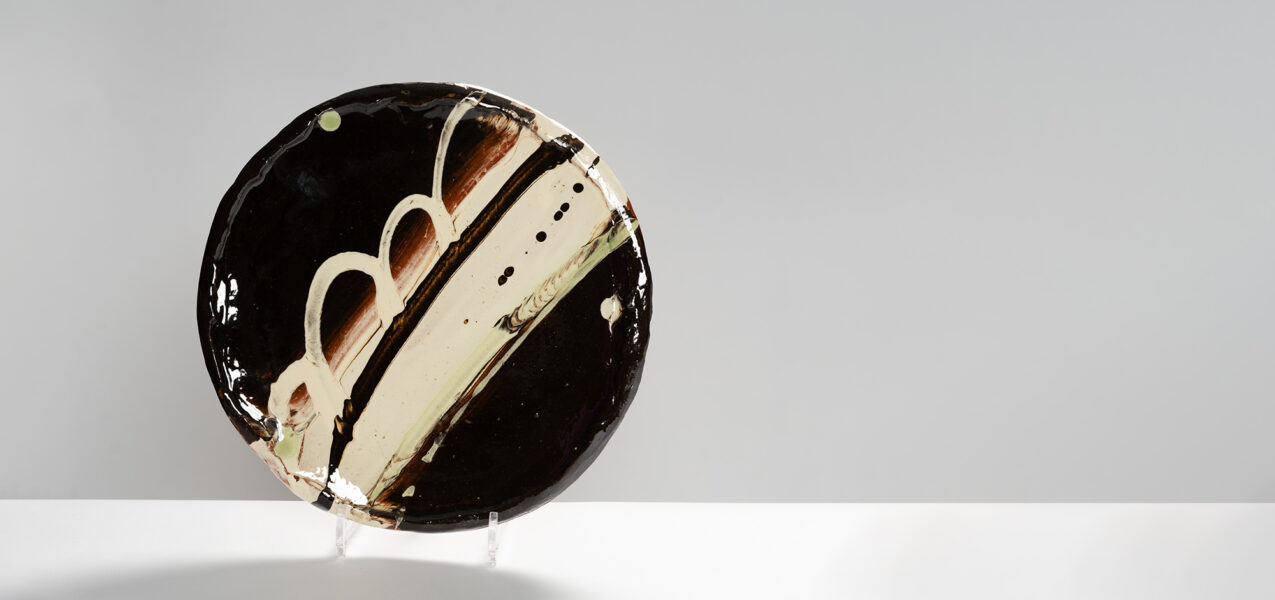
Born and brought up in Norwich, Richard has been making pots since the early 1970s. After studying for two years at Great Yarmouth College of Art, he worked from 1974 to 1980 at Le Dieu Pottery in Norwich before spending 3 years in Australia and New Zealand, and a further five in Germany. He is inspired by Hungarian and Romanian slipware from the 1800s and by English country pottery. Recently his work has explored colour and abstract patterns in strong forms that capture the ebb and flow of the sea and the landscape of South West Dorset.

While still at school Sotis displayed a talent for art and developed a keen interest in three-dimensional art in particular. He later enrolled in a four-year degree course at the Athens School of Ceramics. After his degree he came to the UK

Emma’s ceramics practice is built on notions of what is known as Emotionally Durable design. She uses the making language of ceramics and a design sensibility to make work which is contemporary and relevant over time.

Following a childhood passion for making, David studied wood/metal/ceramics at Manchester Polytechnic. Following an introduction to traditional Japanese architecture, David developed a broader fascination for Japanese craft and aesthetics, which led him to write his dissertation on Raku. Researching the Raku process in turn, led to meeting master Raku maker David Roberts who offered David an opportunity to work with him.

Clare Conrad's work is an exploration of colour and texture, inspired by the effects of light and ageing on architecture, artefacts and landscape. Her technique of layering vitreous slip onto wheel-thrown vessels, vases and bowls creates a rugged texture.