


Contemporary Ceramics gallery and shop exhibits the greatest collectable names in British ceramics along with the most up and coming artists of today. Our distinguished makers are all carefully selected members of the Craft Potters Association.
All of our makers are members of the Craft Potters Association and each of them have a story to tell.

Paul Philp has been making ceramics for over fifty years. Uniting refined classic forms with highly tactile surfaces to create pieces of strong individual identity Paul builds each piece by hand.
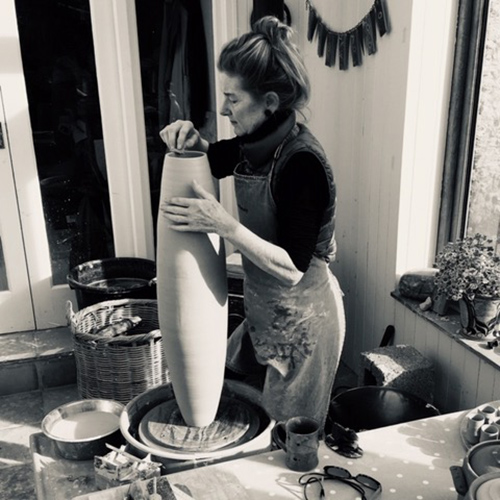
Many years ago, Harriet was inspired by an article by Dick Lehmann about carbon trap glazes. She has been exploring this intriguing glaze ever since. She believes that all the potters who work with carbon trap seek different qualities and achieve quite distinctive effects even though they may use the same recipe and fire to the same temperature in the same kind of kiln. The glaze is unusually responsive to the atmosphere in the kiln and even to the weather as it dries before firing.

While still at school Sotis displayed a talent for art and developed a keen interest in three-dimensional art in particular. He later enrolled in a four-year degree course at the Athens School of Ceramics. After his degree he came to the UK

Sophie MacCarthy has always been drawn to random scatterings of leaves on the ground. Scatter and flow, rhythm and movement are consistent themes in the decoration of her earthenware pieces, along with a bold and joyous approach to colour.

Clare Conrad's work is an exploration of colour and texture, inspired by the effects of light and ageing on architecture, artefacts and landscape. Her technique of layering vitreous slip onto wheel-thrown vessels, vases and bowls creates a rugged texture.

Despite specialising in making one-off slab-built pots during her college years, Ulla established herself as a ceramic jewellery maker for many years. She has however, returned to making individual sculptural pieces. The pots that she now makes are a playful take on classic container forms, particularly the bottle. The shapes have an animated, even anthropomorphic air about them and work well in pairs or in groups.