


Contemporary Ceramics gallery and shop exhibits the greatest collectable names in British ceramics along with the most up and coming artists of today. Our distinguished makers are all carefully selected members of the Craft Potters Association.
All of our makers are members of the Craft Potters Association and each of them have a story to tell.

Emily mostly works with a red stoneware clay that fires to a rich dark brown, with iron speckles showing through the glaze. She occasionally works with porcelain as the white body is ground for wonderful bright glazes. Most of the glazes contain barium and copper, a combination which give rise to interesting matt green glazes in an electric kiln.
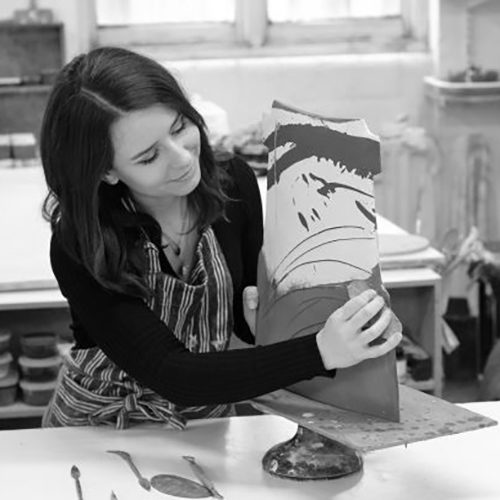
Kirsty graduated from the Fine Art: Painting and Printmaking course at Glasgow School of Art in 2009. She subsequently attended life sculpture classes which led her to working with clay.
Inspired by day-to-day experiences, local landscape and wildlife, Kirsty’s ceramics are an exploration of gesture, form, colour, and place.

Charles was born in New York City in 1939. After graduating from Union University in 1962 with a degree in English Literature, Charles spent the next three years teaching at secondary level. From 1965 to 1971 he worked for a publishing company, dividing his time between the USA and Africa. By 1972 he was juggling a variety of commitments: teaching, travelling, writing and theatre work, mostly in Kenya.
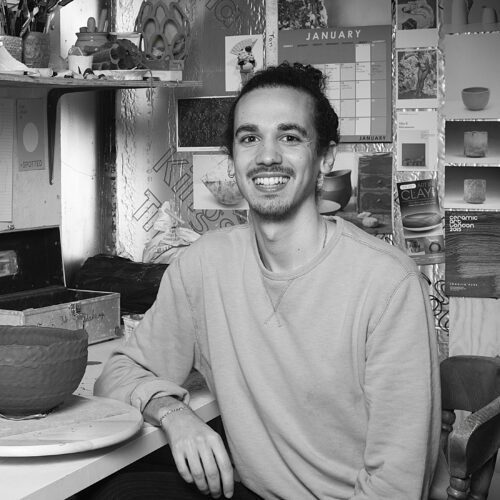
Toni’s work and ethos is centred around the idea of ceramics and its strong association with craft – as a material and its context within the fine art spectrum. He is interested in the history and connotations of porcelain and terracotta. The materials as symbols of trade, status, function, hierarchy; all are factors which correlate with the constant debate regarding crafts and its position within today’s society.

Working with clay allows Sue a secondary voice, a line of communication through form. Her work explores the fragility and hidden strength found within the natural world.
The slow repetitive hand-building techniques she uses to create her pieces offer a considered way to develop the work as each piece calmly grows. Deliberate junctions are made by breaking and re-joining the form where collars or shoulders then evolve. Surface markings are infused into the work during the making, with slips and oxides being applied throughout the drying stage. Built with a white stoneware clay body, the work may be glazed or left bare.

Ian’s work is a contemporary interpretation of country pottery. His salt glazed domestic ware focuses on line, surface and balance. He likes to emphasise tactility and evidence of the maker’s hand, highlighting the subtle marks and fingerprints from handling and attachments. This, combined with clean lines make his work approachable and usable, while giving the work extra durability that comes from the firing process.