


Contemporary Ceramics gallery and shop exhibits the greatest collectable names in British ceramics along with the most up and coming artists of today. Our distinguished makers are all carefully selected members of the Craft Potters Association.
All of our makers are members of the Craft Potters Association and each of them have a story to tell.

Christine-Ann trained at Harrow School of Art and Technology with Mick Casson (1971-73), then worked with David Leach. In London, she started her own workshop as a member of the Barbican Arts Group (1975-83) and in 1976 became a Selected Member of the Craftsmen Potters Association and the Society of Designer Craftsmen. She now works from her home, a converted chapel near Frome in Somerset.
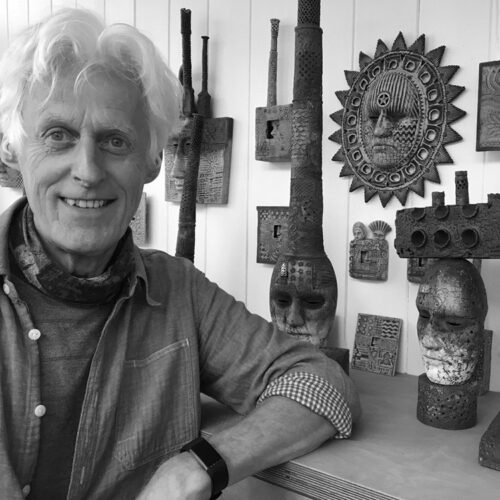
Alasdair Neil's ideas focus on the strange beauty found in the decaying architecture of industrial wastelands. He has built up a large collection of clay and plaster moulds that he has made from the surfaces of found fragments of discarded waste. It is these textures, patterns, shapes and colours that form the thread that runs throughout his entire range of unique hand built forms

Sophie MacCarthy has always been drawn to random scatterings of leaves on the ground. Scatter and flow, rhythm and movement are consistent themes in the decoration of her earthenware pieces, along with a bold and joyous approach to colour.

As a rebellious schoolgirl, Tina always knew that she would go to art college as she absented herself from her maths lessons to go to exhibitions. In 1974, she commenced her BA in Ceramics at Bristol Polytechnic with a strong 2D portfolio but hardly any experience of working with clay and she found it challenging. Nevertheless, she was drawn to it because it was the only material which was so malleable, human, primal, intimate, flexible, fundamental, and could be adapted to suit all personalities.

Duncan’s fascination with clay began as a child in his parents’ garden. The colour, smell and malleability of the earth led him to discover at school the transformation of clay by heat into a permanent object. As a teenager, Duncan was captivated by seeing his teacher throwing a pot on a kick-wheel, his bedroom posters were images of communist revolutionary heroes and 20th-century studio pottery.

Ian’s work is a contemporary interpretation of country pottery. His salt glazed domestic ware focuses on line, surface and balance. He likes to emphasise tactility and evidence of the maker’s hand, highlighting the subtle marks and fingerprints from handling and attachments. This, combined with clean lines make his work approachable and usable, while giving the work extra durability that comes from the firing process.