


Contemporary Ceramics gallery and shop exhibits the greatest collectable names in British ceramics along with the most up and coming artists of today. Our distinguished makers are all carefully selected members of the Craft Potters Association.
All of our makers are members of the Craft Potters Association and each of them have a story to tell.

Carina trained as an industrial designer in Germany and specialised in furniture design. One day she found herself at a ceramic studio near her house. She had a sudden realisation that there was no difference between making a teapot or a chair because it's all about aesthetics: form, function, balance, and proportion.
Carina had no formal ceramic education and through apprenticeship, short courses, and residencies she has learned and worked with different clays in different parts of the world. She explores the potential and qualities of each clay body, a continuous conversation unfolding between the maker and the material.

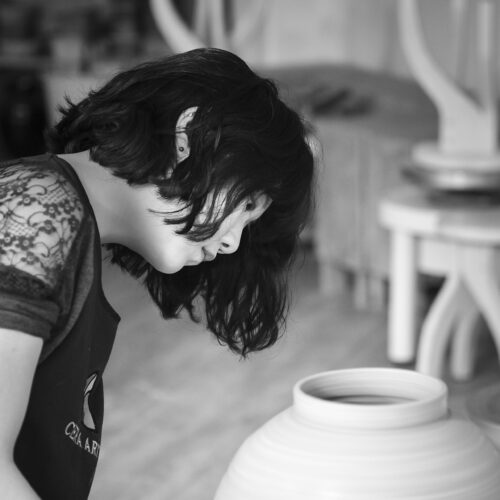
SaeRi strives to intertwine personal narrative with broader social and cultural influences, creating a visual representation of her experiences. Central to her artistic exploration is the profound impact of the "good child syndrome" that has shaped her identity since her youth. This complex, deeply rooted in societal and cultural expectations, has greatly influenced her journey as an artist.

Kay Aplin graduated in 1995 from Chelsea College of Art, specialising in ceramics and glass. Since then, Kay has had a successful career as an architectural ceramist, producing a distinct range of site-specific commissions for the public realm around the UK and internationally.

Katie studied ceramics as part of her degree in Cheltenham and went on to teach in secondary education specialising in ceramics. Drawn to working with clay from a young age and inspired by the landscape and seascape around where she lives, Katie is particularly influenced by the manmade and natural marks in the environment. She enjoys the nature of the material and the meditative quality of hand building, as well as the malleable quality of clay which retains a sense of the maker’s hand.

When Bev was at art school in the late sixties, her final thesis focused on the relationship between natural forms and clay. However, it was only since 1978 when she moved to Wales, that she developed her work to relate directly to where she lives.