


Contemporary Ceramics gallery and shop exhibits the greatest collectable names in British ceramics along with the most up and coming artists of today. Our distinguished makers are all carefully selected members of the Craft Potters Association.
All of our makers are members of the Craft Potters Association and each of them have a story to tell.
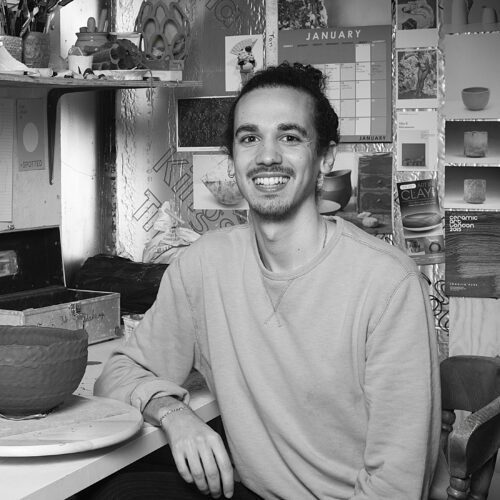
Toni’s work and ethos is centred around the idea of ceramics and its strong association with craft – as a material and its context within the fine art spectrum. He is interested in the history and connotations of porcelain and terracotta. The materials as symbols of trade, status, function, hierarchy; all are factors which correlate with the constant debate regarding crafts and its position within today’s society.

Rachel studied Ceramics at Cardiff School of Art and Design, graduating in 2000. Inspired by the ever-changing colour and light within the landscape, Rachel combines artistic expression with traditional craft skills and an innovative decorating technique to create abstract compositions on a clay canvas.

Despite specialising in making one-off slab-built pots during her college years, Ulla established herself as a ceramic jewellery maker for many years. She has however, returned to making individual sculptural pieces. The pots that she now makes are a playful take on classic container forms, particularly the bottle. The shapes have an animated, even anthropomorphic air about them and work well in pairs or in groups.

From an early age Penny enjoyed playing with clay at home as her mother had a small pottery studio. However, it was not until she lived in Japan in her twenties that she became more seriously interested in making pots.

Jane’s work is about finding beauty in the ordinary. It’s about the small things and recognising the accidental poetry in the unnoticed and overlooked. Living in the city, this is often found in apparently insignificant details of the built environment - the way a surface has weathered, the juxtaposition of materials, the sculptural qualities of found forms.

Martin describes his work as ‘ Clay – Water – Wood – Fire – Space’. These five elements are synthesised to create a reversed trompe-l’œil type of work, seemingly excavated or revealed, and simultaneously diminishing the third dimension.