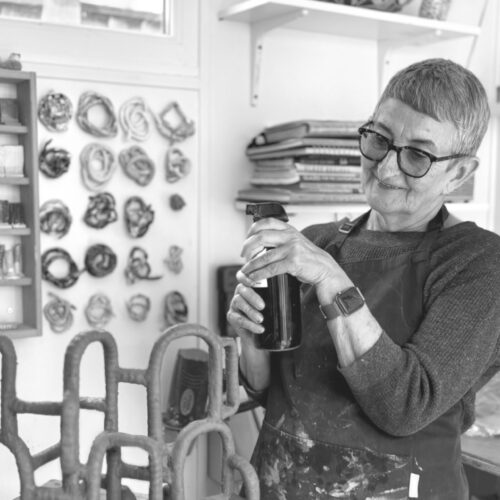
Contemporary Ceramics is excited to present David Binns and Paul Wearing | Of The Land. As part of this joint exhibition, which runs from Thursday 16th October – Saturday 8th November 2025, we spoke with each of the artists. In this post, we talk to David Binns, and delve into his creative process and learn more about how he works.
Contemporary Ceramics: How has your work grown or changed for this exhibition? What kind of journey do you hope to take your audience on?
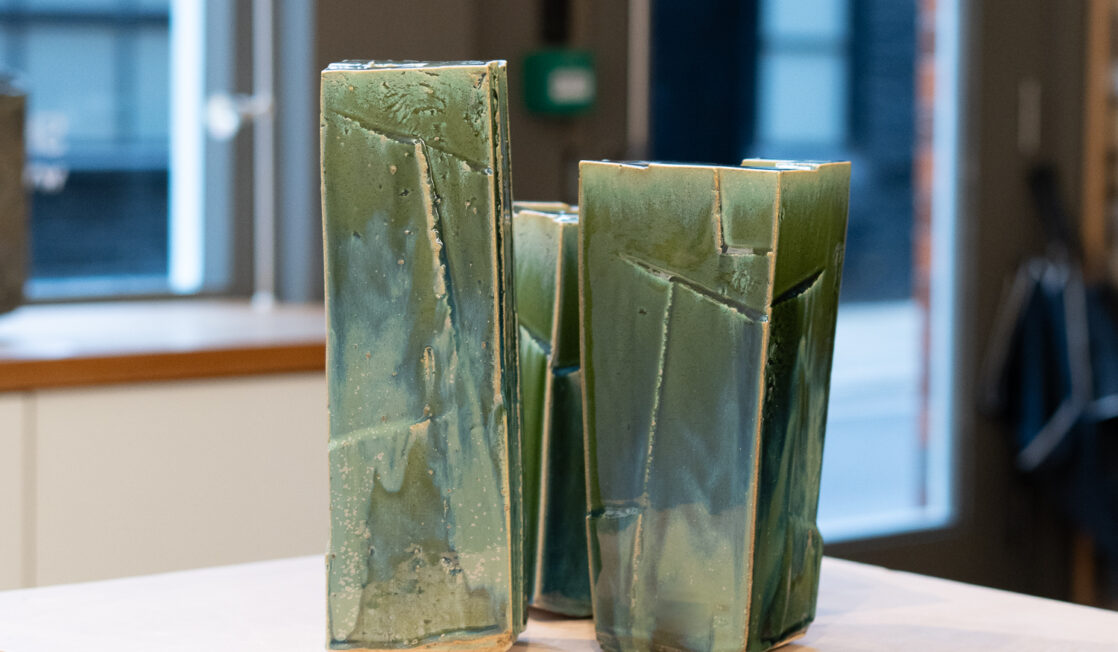
David Binns: Whilst my work has not specifically changed for my current CCG exhibition, having a show in this prestigious venue hugely focussed my thinking – creating an opportunity to reflect on my practice and hopefully gain a better understanding of what I wish to say through my work.
I hope anyone seeing my work in the ‘Of the Land’ exhibition will firstly see and feel a quiet beauty – I don’t feel any desire to communicate a profound message. I simply hope the viewer gets pleasure from my pieces and maybe sees qualities in the shapes and surfaces that remind them of our beautiful and extraordinary natural world.
If my work asks questions of purpose and how they were made, that would be great too!
Contemporary Ceramics: You describe using woodworking chisels to carve into the leather-hard clay. This is a fascinating crossover of materials and methods. Could you tell us more about how the disciplines of ceramics and woodworking inform each other in your practice, and how this relationship influences the character of your finished pieces?
David Binns: Throughout my childhood and the majority of my art degree, I was obsessed with making objects from wood. It was almost by chance that I swung my attention to working with clay. I have, in the past used many more conventional ceramic making processes. However, over time I have grown to better understand what I want to say through clay – instinctively and almost subconsciously developing techniques and making processes that borrow from my woodworking past.
Within my current work, I also work the clay when it is very firm, which allows me to make cuts and marks that are possibly more akin to wood than clay.
So undoubtably my love of working with wood and the tools used in cabinet making massively informs my current ceramic work.
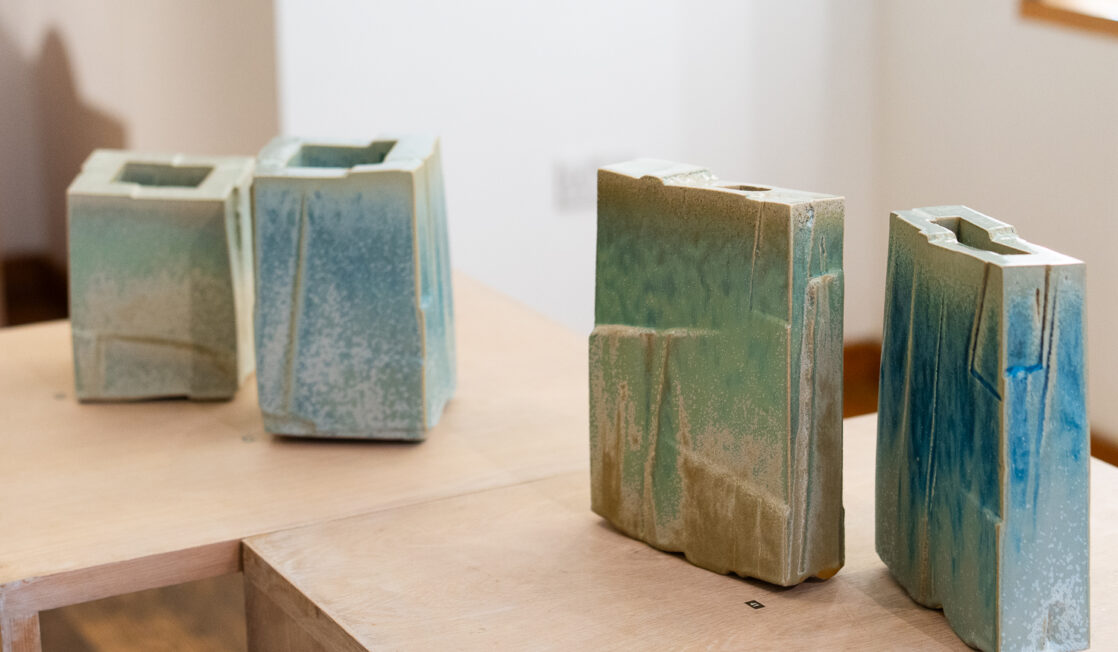
Contemporary Ceramics: You describe how, by firing to a very high temperature, “the clay body itself plays an important role in affecting the aesthetic qualities of the fired glaze”. How this process gives each piece an unrepeatable quality. What draws you to embrace this unpredictability in your practice?
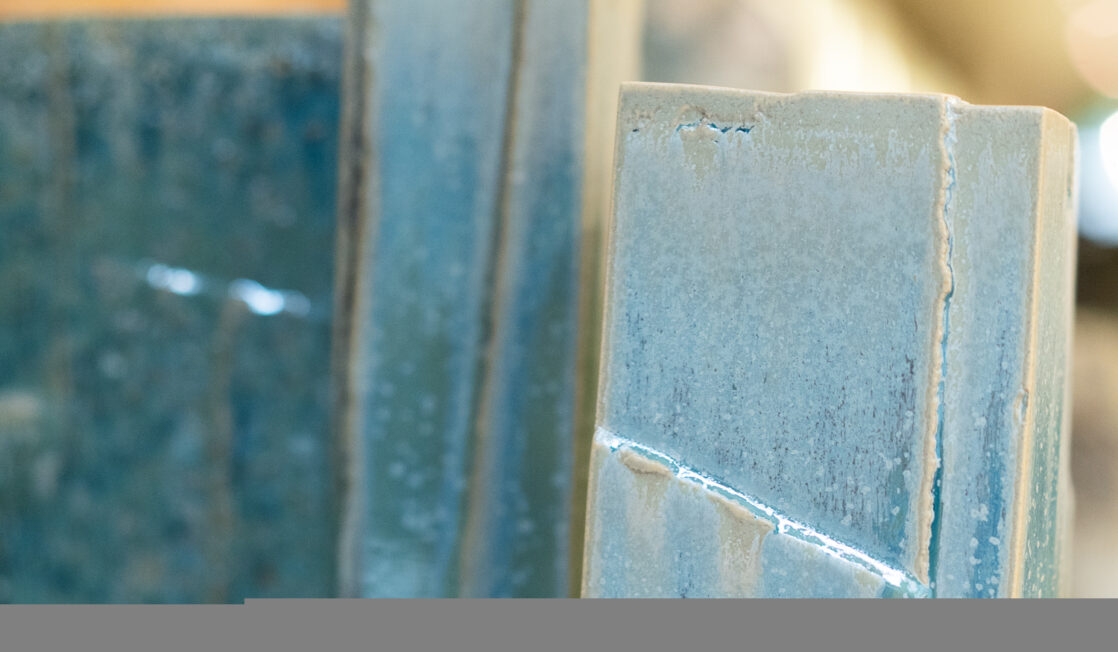
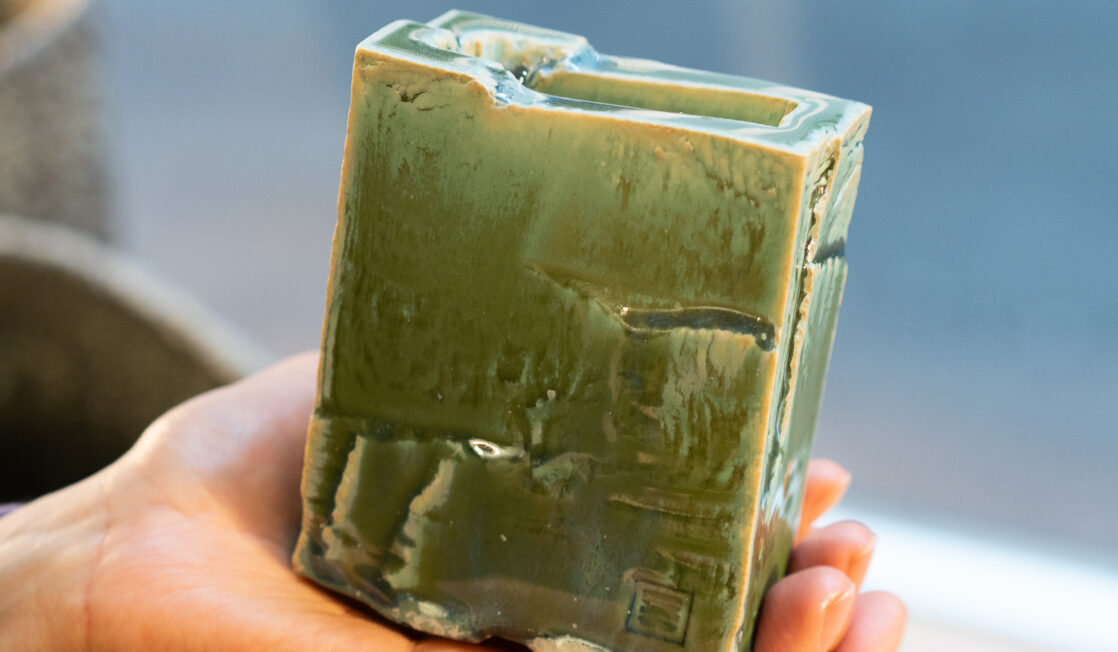
David Binns: The higher one fires glazed ceramic forms, the greater is the interaction between the underlying clay body and the glaze. This is hugely important to me, as it creates a feeling that the surface is an integral part of the body of the piece, rather than an applied secondary, decorative skin. Again, there is a connection here with my love of wood, where the surface of a piece of timber reflects what is inside. The same applies to a cut or carved piece of stone, which I also love.
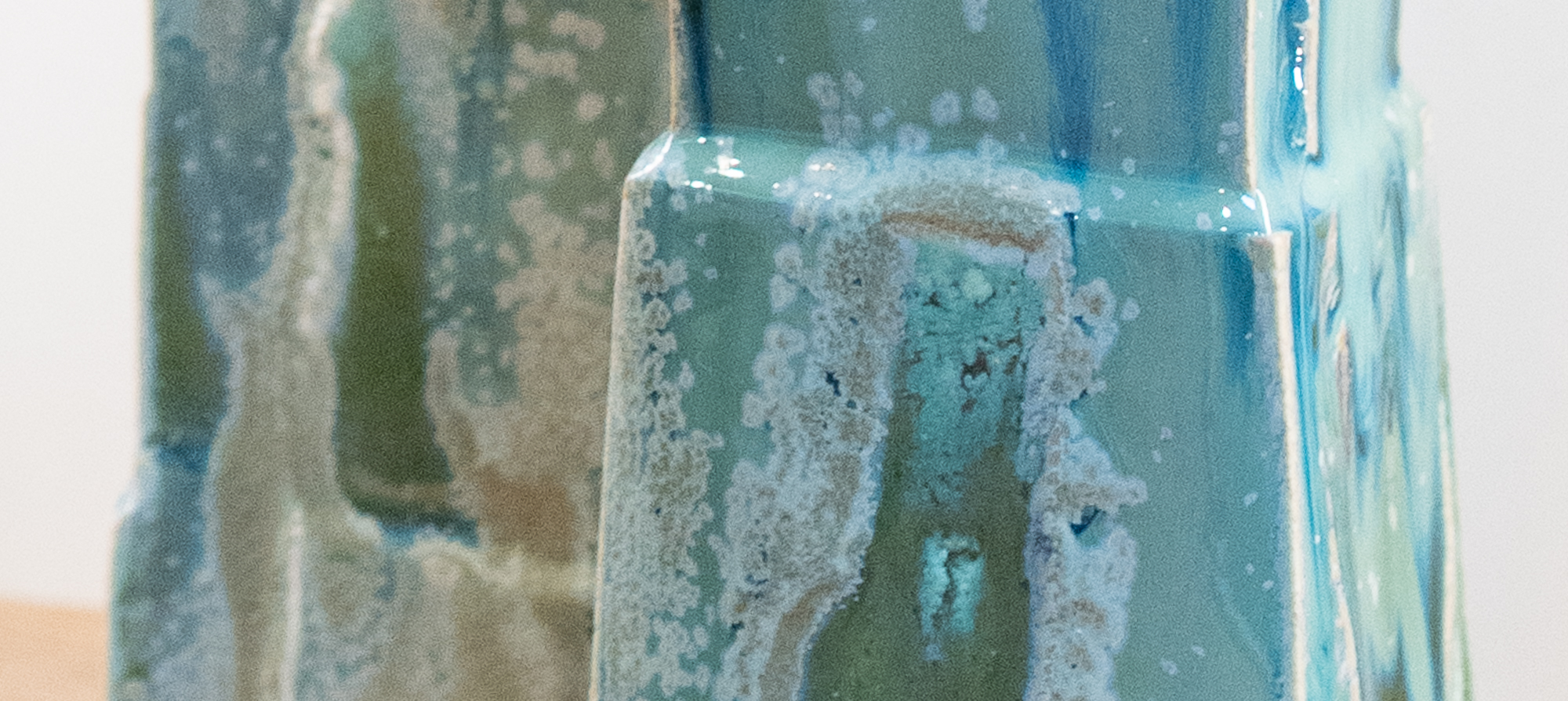
The unpredictability / uniqueness of each piece, is partly down to the way the glaze interacts with the underlying clay body, but it is more to do with glaze thickness and firing temperature. I spray the glaze on all my larger pieces, and it is almost impossible to control exactly how much glaze is applied through the spray gun. A very subtle change in glaze thickness can make a big difference to the finished glazed surface. And a couple of degrees difference in firing temperature, can also dramatically affect the glaze effect. The rate of cooling can also have a big effect too. Whilst I can control my kiln temperature very accurately, each firing involves a unique set of circumstances – glaze thickness, position of pieces in the kiln and the volume of ware in the kiln, all of which contribute to the unpredictability.
Whilst many makers need to feel in control and aim for predictable results, I actually relish the unpredictability of each firing. Of course I want every firing to be successful, but I actually seem to enjoy the uncertainty – never quite knowing what is going to come out. This approach also means each piece is completely unique and unrepeatable. As a consequence of this I have mixed emotions of excitement and anxiety when every kiln is about to be opened. Bizarrely I seem to thrive on this and it is what drives me to keep making.
Contemporary Ceramics: How has your practice changed over time? What has been a seminal and/or inspirational moment?
David Binns: My practice has gone through a number of significant changes over my creative life. I began my ceramic journey on my degree course, making thrown raku pots loosely based on early Mediterranean pottery. Then for many years I didn’t make any vessel forms. I made large pierced, unglazed slab shapes in various terracotta bodies, which gradually morphed into making large, solid sculptural forms where I added various aggregate inclusions to the clay – found and made. These pieces reminiscent of terrazzo and natural stone, involved a significant amount of cutting, grinding and polishing to finish them.
I then embarked on a more experimental phase, using increasing amounts of recycled waste material in the pieces – driven by my evolving concerns about the environment. Eventually I found I was able to make large sculptural forms from 100% recycled waste ceramic, glaze and glass. I realised I had developed a unique new material that was a hybrid of ceramic and glass making. Through further focussed research and development, I started recognising this unique material / process of making I had developed, had interesting commercial potential, as a way to make tiles and other architectural surfaces from 100% recycled waste. Around 10 years ago, I co-founded a company called ALUSID, which now makes both mass-produced and bespoke products from 100% recycled ceramic waste. The company has fulfilled many exciting projects in shops, restaurants and offices all over the world.
The ‘ALUSID project’ has been an interesting journey, taking my creative practice from a craft studio, through to high volume, industrial manufacturing.
In 2018 I was invited to go to Japan to give a workshop / demo on the recycling process I had developed. The workshop took place in famous pottery town of Mashiko, where Shoji Hamada lived and worked. Following my workshop in Japan, Hamada’s grandson Tomoo Hamada initiated a project to celebrate the 100 year anniversary of the connection between the Leach Pottery in St Ives and Mashiko. They used my recycling technique to make 2 large signposts, made from broken shards of Mashiko pottery and fragments of Hamada’s kiln that had been damaged in the 2011 earthquake. One sign is sited at the museum in Mashiko, the other in the garden of the Leach Pottery.
As the process of creating shapes from recycled waste now had a new life with ALUSID, I felt it was time to re-evaluate my practice and ‘return to basics’! My current work emerged from these thoughts. It is the first body of work in my entire 40 year ceramic career that I have made glazed vessel forms – a seminal moment I guess!!
Having taught glaze technology throughout my University lecturing career, it seemed about time I personally made use of this knowledge!
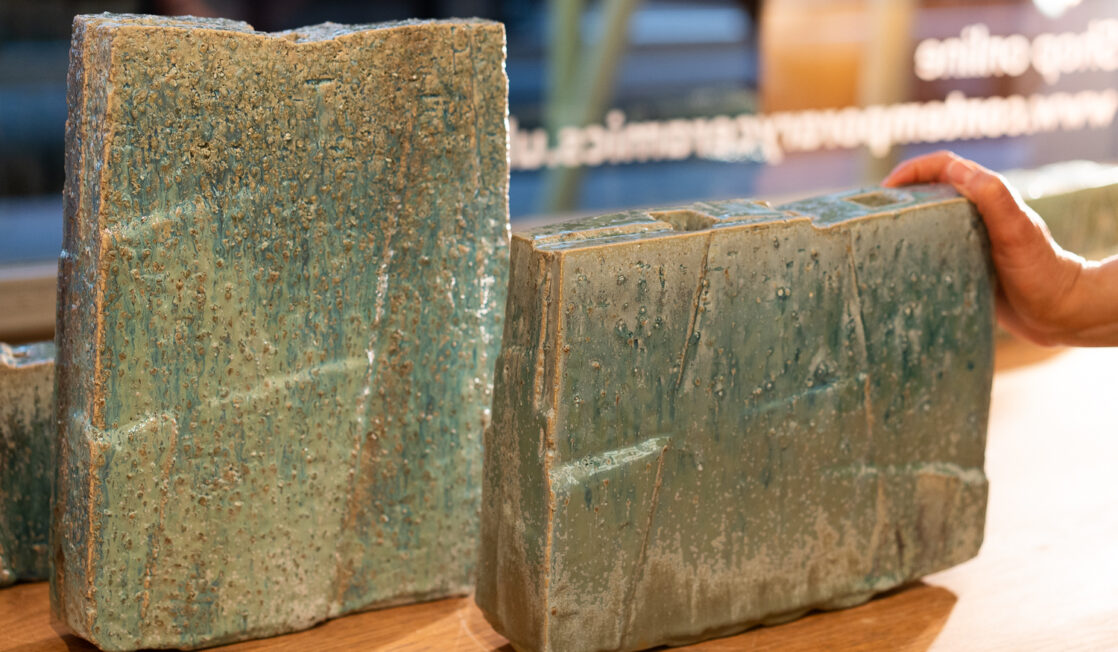
Whilst my current work is clearly very different to anything I have made before, I still feel there is an underlying connection – pieces are still heavy and I think convey a feeling of ‘monumentality’, even in tiny examples of work.
Contemporary Ceramics: Has clay always been your artform? How did you first get involved in
working with clay?
David Binns: As I explained in an earlier question, my original, intended material of choice was woodworking / cabinet making. In fact, throughout my childhood, I actually wanted to be an architect. Woodworking emerged as a potential career route only when it dawned on me that architects don’t generally make things with their own hands.
My art foundation course was my first encounter with clay – and I hated it! After one clay class, I escaped back into the woodworking workshop.
My degree course however was a multidisciplinary 3D Design programme, requiring students to spend the 1st year equally studying, wood, metal and ceramics.
I reluctantly attended clay classes and gradually found myself enjoying throwing and then kiln building. Although I think my interest in kiln building was actually a way to fulfil my architectural aspirations.
I was still majoring in wood mid-way through my final year, until a chance encounter with master Raku maker David Roberts changed my life plan. Amazingly, he offered me the opportunity to work with him on graduating from my degree. So midway through my final year, I did a U-turn and started specialising in ceramics. As they say, the rest is history.
Contemporary Ceramics: What was the first piece of art that really mattered to you?
David Binns: I have always enjoyed a wide variety of art, but without doubt for me the most profound and inspiring artwork I have ever seen is the work of Donald Judd and Constantin Brancusi. And they both happened to have exhibitions at the very same time at Tate Modern in 2004 – another seminal moment! Judd’s piece involving 4 large steel cubes set out in perfect alignment, is probably the piece that had the most profound impact on me.
Whilst very different, both artists were interested in purity of form and honest use of materials, never adorned with applied decoration. Their combined artistic philosophies have shaped my creative life – alongside a deep love and respect for traditional Japanese architecture and Zen gardens.
Contemporary Ceramics: Do you find inspiration from elsewhere? What images keep you company
in the space where you work?
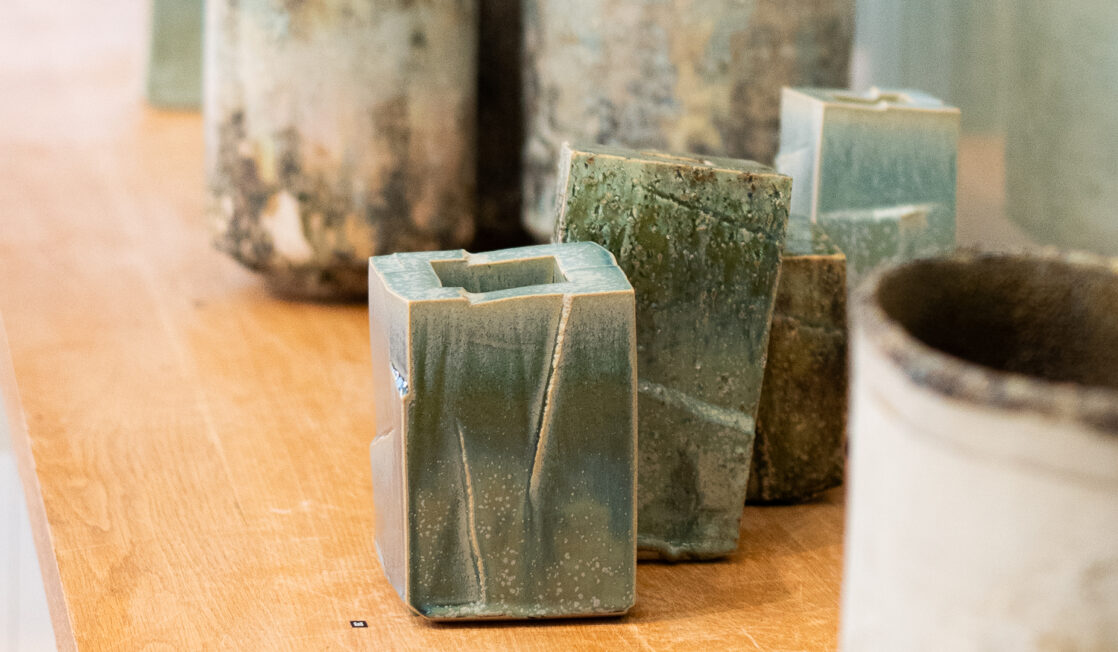
David Binns: Aside from being inspired by my love of woodworking, my work is inspired by shapes, textures and colours one finds in the natural landscape. I am deeply moved by the natural environment, particularly the geology of mountainous areas and rock faces.
I never directly attempt to copy or imitate nature – rather I hope my work alludes to qualities one might see in nature.
I also love very minimalist, modern architecture. Again, I never copy, but it is there somewhere in the back of my mind.
And Japanese aesthetics play a big part in my thinking. The aesthetic terms Shibui, Shizen and Fukinsei, together convey the values and qualities I hope to convey through my work: unobtrusive quiet beauty, a harmonious relationship with nature, spontaneity and an appreciation of asymmetry and irregularity.
I don’t currently have any images up in my studio. I am however very fortunate in that the window in my studio gives me an uninterrupted view over our garden and across fields down a valley – all the inspiration I need. And my faithful, beautiful and slightly crazy little collie Flo also keeps me company!
Contemporary Ceramics:How does working with clay influence your life beyond the workshop?
David Binns: I think in many ways working in clay defines my life. I think I would be lost without it. When I am out, albeit in the city or the mountains, I am continually noticing qualities that may possibly (indirectly) inform my ceramic making in some way.
Working in clay has also provided a wonderful, global community of fellow makers, many who are very good friends. The fellowship between makers of all generations and cultures, is I think, an inspiring and unique aspect of working with clay
The most complementary thing anyone ever said to me was that if I was cut in half, the word ‘Ceramics’ would be written through me like a piece of seaside rock. Although I believe that could also be said of many of my fellow ceramic makers!