Contemporary Ceramics is excited to present New Members of the Craft Potters Association. As part of this group exhibition, we delve into the artists’ creative process and learn more about how they work. The exhibition runs from the 5th – 28th February 2026.
Loraine Rutt

The Exhibition
Contemporary Ceramics: How has your work grown or changed for this exhibition?
Loraine Rutt: Over the past decade I’ve become best known for ‘Pocket Globes’ for which I make wood and mixed media protective cases containing celestial charts that reference our planet’s place in the solar system. For this exhibition I wanted to work purely in ceramics, in particular pairing forms which reveal more combined than their individual components.
Everyone’s experience of place is individual, and our views of the world unique and ever shifting. My hope with these pieces is that I can take the viewer on a journey of connection.
On Maps and Perception
Contemporary Ceramics: Your work explores how maps shape our sense of place and belonging. How do you decide which geographical or social themes to highlight in a piece, and how do you convey them through clay?
Loraine Rutt: Some of the themes are ad hoc, often in response to a news story. I’m particularly concerned about the surge in partisan, divisive politics. At their core my globes are about the view of Earth from space where no political boundaries are visible.
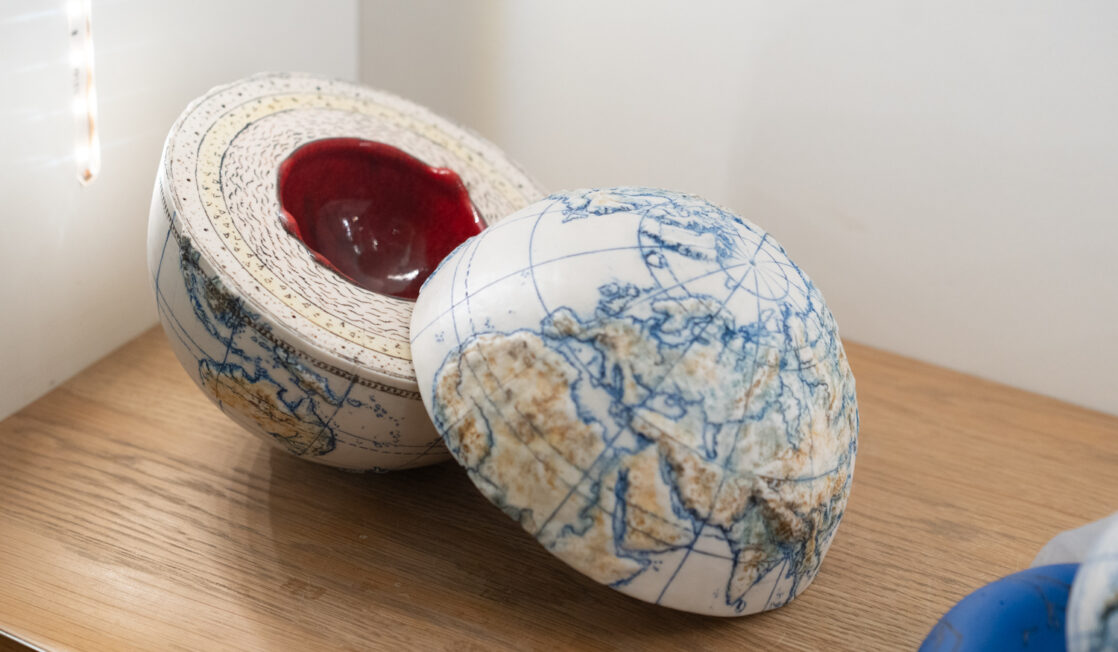
Divided Globe plays on the idea that half the Earth is no good to anyone. It is based on a 1960’s geography textbook illustration showing the layers of the earth’s mantle and core. Whilst this is essential knowledge, mapping this raises questions of consumption, extraction and control of mineral rights. As ceramicists most of our materials are provided by extraction in some form, and I am mindful of this in what and how I use material. The inlay is a mix of reclaimed oxides from painting other pieces, with minimal manganese and iron added. The glaze contains ‘Our Carbon’, a carbon negative material derived from sewage waste diverted from landfill.
On Transforming 2D to 3D
Contemporary Ceramics: You describe the process of turning two-dimensional maps back into three-dimensional objects. How do you balance accuracy with artistic interpretation when creating these forms?
Loraine Rutt: This is a constant challenge; it is trying to balance left and right brain activities! I do feel I need to loosen up a little bit and let the clay speak more. However, even though I generally start with quite a tight, accurate drawing and sometimes a paper model too I always try to let the making marks reveal the clay forming process, letting the finger prints etc be part of the surface.
For the relief-based work I make models and moulds from which I slip cast or press mould. Being able to duplicate the form gives me the freedom to be a bit more creative with the surfaces.
In terms of balancing accuracy and interpretation, having given myself the challenge of making things accurate the making becomes a process, and the nuances of each piece evolve with the soft clay in my hands. Thin slabs of porcelain will move in ways that dry paper doesn’t, so although I might start with a paper model, I listen to the porcelain and let it fold and bend how it feels right. If I try to force a shape, it will just crack. I think it becomes a subliminal moment of knowing when the form feels right and will carry the map.
On Technique and Material
Contemporary Ceramics: Your pieces involve intricate scribed lines and layered oxides on porcelain. How does working with such a delicate material influence your approach to detail and surface decoration?
Loraine Rutt: Most of my work starts with a detailed drawing of surface design, which sometimes dictates or inspires the form. I trace through the paper onto soft porcelain, which leaves a rounded indent; a ghost of the paper and process. Sometimes I pierce the design through the paper, a technique known as ‘Pouncing’. This process has been used for centuries, both in ceramic decoration and duplicating manuscript maps.
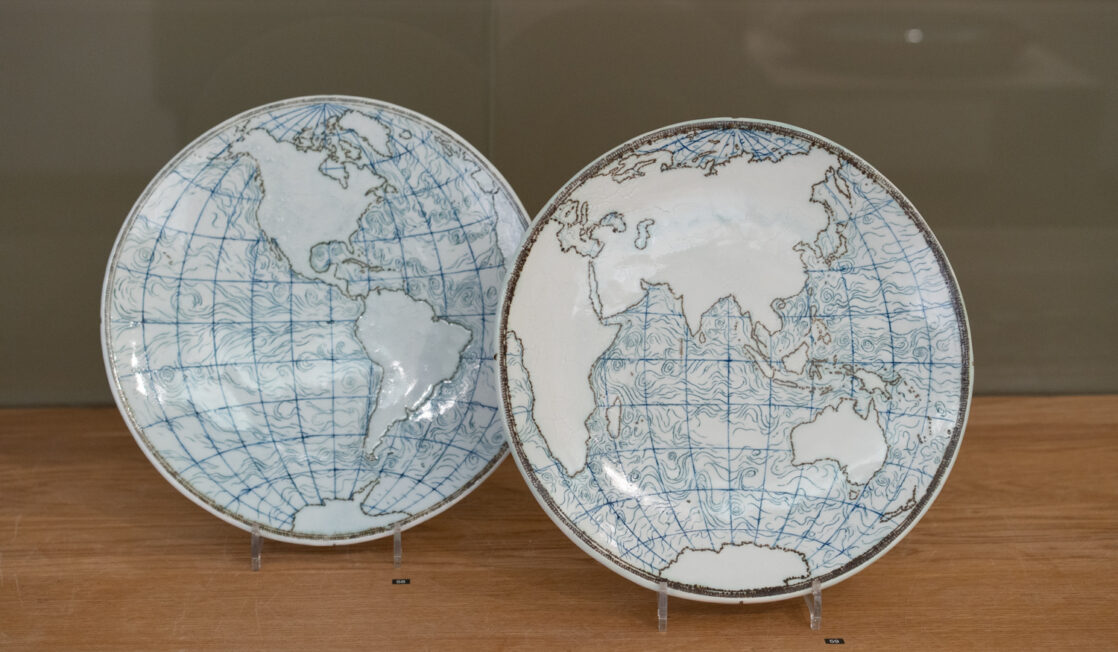
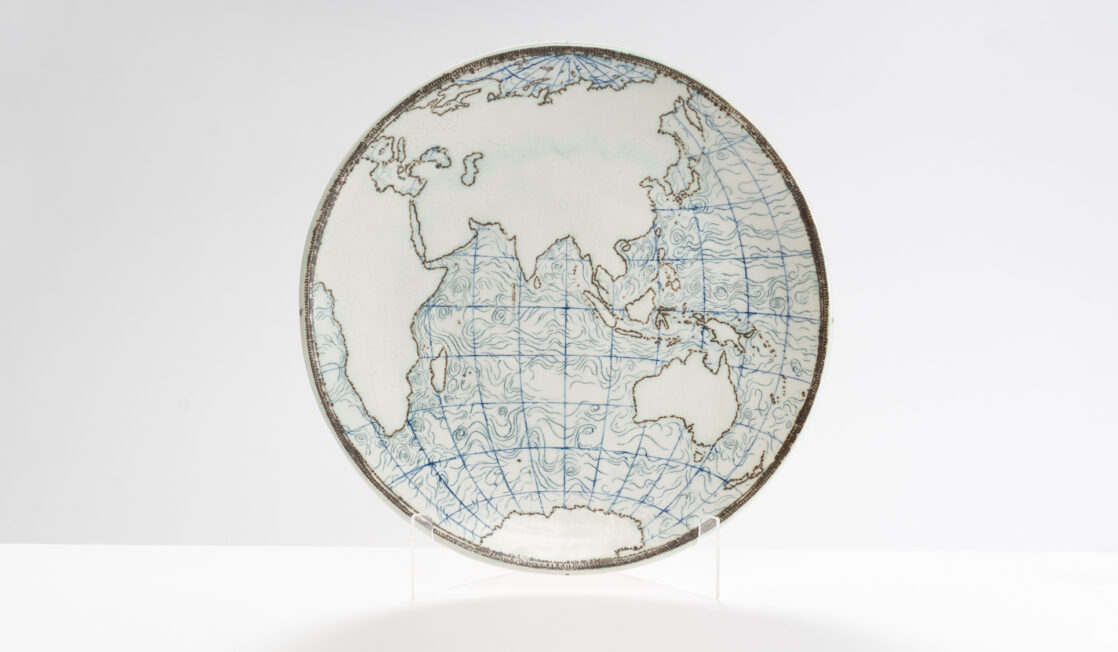
I use custom-made needle tools, clock cogs (which give a subtle nod to the passage of time in the Earth’s rotation), and scalpels to incise the line work onto leather-hard clay. The satisfying scrolls of clay peel from the surface in a similar way to the scribing of light sensitive film used in map making when I trained as a cartographer. I like this symbiotic relationship cross-over from disparate craft disciplines. I think my background in map-making has definitely influenced opting for the paper-white and paper-like qualities of porcelain. The tactile qualities of honed porcelain feels very similar to a printed Ordnance Survey map.
On Growth and Development
Contemporary Ceramics: How has your practice changed over time? What has been a seminal and/or inspirational moment?
Loraine Rutt: I moved from making coiled ceramics that were loosely inspired by maps to making maps from clay. It’s a subtle difference, but it meant bringing my cartographic skills to the ceramic workbench and seeing how far I can push the accuracy and refine surface without losing the essential essence of clay as the medium.
This shift happened about 20 years ago whilst walking on One Tree Hill, where on a winter’s day you can see through the bare trees to the panorama of the London Basin. It reminded me of a map I had drawn for London University which was a contour map of the city. It fascinated me to see the landscape on a map where the built environment usually dominates. It was a realisation that this brick-built city had evolved from the clay it was sited upon, and that I could use this abundant resource to make representations of the Earth’s surface.