


Contemporary Ceramics gallery and shop exhibits the greatest collectable names in British ceramics along with the most up and coming artists of today. Our distinguished makers are all carefully selected members of the Craft Potters Association.
All of our makers are members of the Craft Potters Association and each of them have a story to tell.
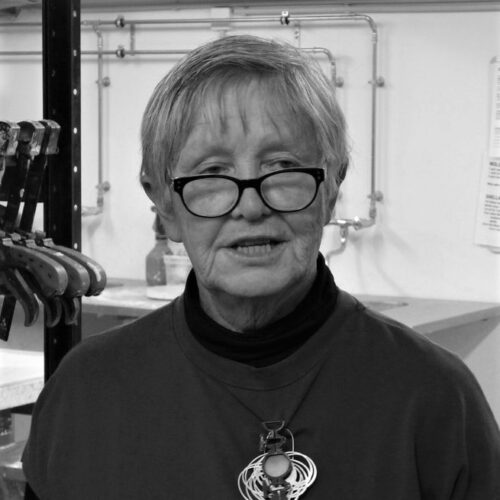
Priscilla was born in Cape Town, South Africa and attended the School of Art in Durban before setting up her own ceramic studio in England in 1968. She spent a decade in England before moving to Denmark where she has lived and worked since.
Priscilla makes porcelain pinch pots with graphic surface etchings revealed in underglaze. Her monochrome pots are often wood-fired.

Kay Aplin graduated in 1995 from Chelsea College of Art, specialising in ceramics and glass. Since then, Kay has had a successful career as an architectural ceramist, producing a distinct range of site-specific commissions for the public realm around the UK and internationally.

Annabel was born in Germany and spent several years of her childhood in Egypt before coming to England in 1956. She discovered clay at Farnham Art School on Saturday morning classes in the early 1960s. After leaving school in 1967, she attended Winchester Art School, where she was introduced to conceptual art and concrete poetry, and then Croydon College of Art. She went on to gain a BA(Hons) in Sociology and a PhD in Lesbian History at Essex University, then introduced and taught Lesbian Studies at Birkbeck College for two years. In her early 40s, she returned to her first love of clay, as one of the initial students on the City Lit Ceramics Diploma course in 1989.

Emily-Kriste Wilcox works from her studio in Birmingham, and has been a professional ceramicist for over 15 years. She was recently awarded 'Best Ceramics and Painting Studio 2020' in the West Midlands category of the UK Enterprise Awards.

John Pollex has carved his own niche into the world of studio pottery. Translating his interest in Zen calligraphy into the spontaneous and mesmerising display of colour his work is known for today.

Adam uses a single pure jar form as a canvas to map his observations from an ongoing study of his surroundings. He incorporates stone and locally dug clay into his work to create a narrative, one that conveys a unique sense of place.