


Contemporary Ceramics gallery and shop exhibits the greatest collectable names in British ceramics along with the most up and coming artists of today. Our distinguished makers are all carefully selected members of the Craft Potters Association.
All of our makers are members of the Craft Potters Association and each of them have a story to tell.

Daniel graduated from the Harrow Studio Ceramics course in 1991, then had a shared workspace space at Kate Malone’s Balls Pond studios in London before returning to work as a technician and studio manager on the Harrow ceramics course. In 1997, he moved to West Wales to set up a studio on a smallholding where he has continued to develop his work and firings for the past 23 years. Daniel exhibits widely across the UK, Europe and internationally.

Moyra Stewart has worked in clay for more than forty years after graduating from Edinburgh College of Art in 1979. Her work has been exhibited across the UK, in Canada and Japan, and in 2015 she was awarded Craft & Design Maker of the Year prize.
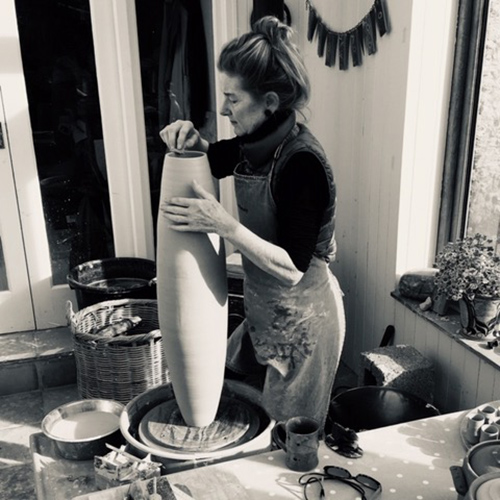
Many years ago, Harriet was inspired by an article by Dick Lehmann about carbon trap glazes. She has been exploring this intriguing glaze ever since. She believes that all the potters who work with carbon trap seek different qualities and achieve quite distinctive effects even though they may use the same recipe and fire to the same temperature in the same kind of kiln. The glaze is unusually responsive to the atmosphere in the kiln and even to the weather as it dries before firing.

Nicola’s pottery is the culmination of 35 years making ceramics since studying Painting at Central School of Art and training at Aldermaston Pottery with Alan Caiger-Smith. She continues to work in tin-glaze, having perfected six main colours from vibrant coral and yellow through vivid greens and blues to soft purples. Her brushwork designs are inspired by the natural world, predominantly leaves, flowers, fruits and birds also sea creatures that all dance over the pearl white surface.

Claudia trained as a painter but transferred to pots because she found the turning surface sympathetic to an unfolding visual narrative. Stories are her raw material - both her own and other people's, also fictional stories, songs, and poetry. The human, cultural, and historic associations of pottery connect particularly well to the work she does interpreting women’s histories and contemporary lives. The nature of pots is that they can break, and so can be mended. This she finds to be a compelling metaphor for both trauma and survival - the mending has an optimistic quality.

James and Tilla Waters create their pieces from a studio in Mid-Wales. Carefully considering where hands hold pieces and edges meet mouths, their forms have classic clean lines with beautifully balanced proportions.