


Contemporary Ceramics gallery and shop exhibits the greatest collectable names in British ceramics along with the most up and coming artists of today. Our distinguished makers are all carefully selected members of the Craft Potters Association.
All of our makers are members of the Craft Potters Association and each of them have a story to tell.

Jo specialises in wheel-thrown porcelain and works from her studio in Hackney, East London. Her practice includes hand-making a fine porcelain design range, lighting and unique objects. Her individual approach to wheel-thrown ceramics, where high-fired porcelain often appears paradoxically to be fresh off the wheel, balances softness with rigidity, smoothness with weight and tactility.

Sean's love of slipware first began whilst attending the studio pottery course at Harrow College of Art in the late 1980s. Now 30 years and three workshops later he is still making slipware. Since 2007, after moving from London, Sean has been working in an old converted stone barn in Southern Brittany, France.
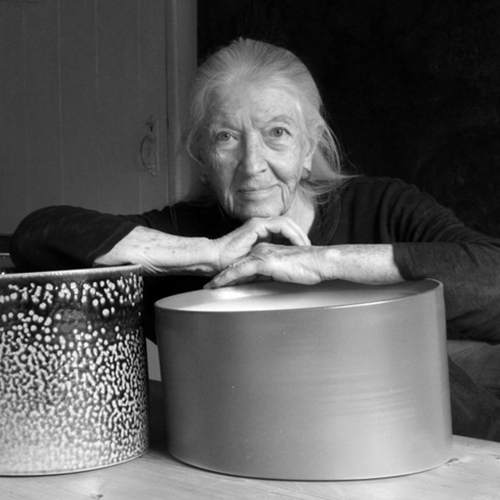
Jane Hamlyn's life as a full-time professional potter began in 1975. She chose to work in salt-glaze, an unpredictable technique with a short history and undiscovered potential.

All bowls Sara Moorhouse makes are thrown on a wheel using white stoneware clay or porcelain. The banded bowls are then turned and bisque fired before being returned to the wheel and hand painted with underglaze colour. The Colourblock series are turned and then the lines drawn on using a laser level, which are then taped and hand painted. The white porcelain bowls are handed carved either on or off the wheel, depending on the arrangement.

Suzanne began working with clay while accompanying her husband during their years living in the Middle East in the 1960s and 70s. She came to make clay her home ground and something she could take with her wherever she lived.
She discovered Oribe ware – Japanese tea ceramics associated with the Kaiseki meal and tea ceremony – whose glazes and playful geometric decoration greatly influenced her aesthetic. She ultimately decided to import English porcelain clay so she would have continuity wherever she worked and for the same reasons travelled with a small electric kiln.