


Contemporary Ceramics gallery and shop exhibits the greatest collectable names in British ceramics along with the most up and coming artists of today. Our distinguished makers are all carefully selected members of the Craft Potters Association.
All of our makers are members of the Craft Potters Association and each of them have a story to tell.

Ant first encountered pottery in primary school. His teacher, Mr Wright introduced him to clay and planted the beginnings of a lifelong passion. He started out as a science teacher but gave up teaching in his late twenties after years of evening classes and moved to Lincolnshire to set up his own pottery workshop.

The careful traditions of English slipware are unseated and then thoroughly reworked through the ceramics of Dylan Bowen who has taken this English inheritance and very definitely made it his own.
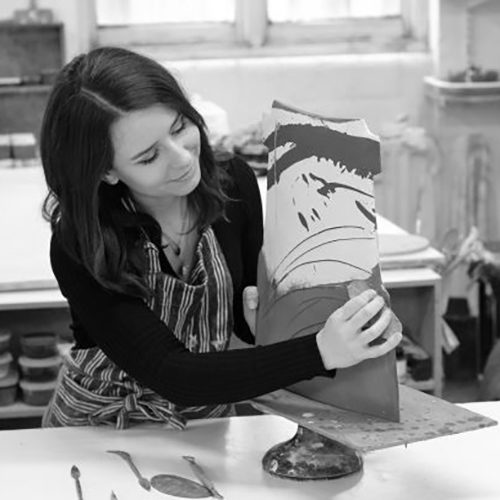
Kirsty graduated from the Fine Art: Painting and Printmaking course at Glasgow School of Art in 2009. She subsequently attended life sculpture classes which led her to working with clay.
Inspired by day-to-day experiences, local landscape and wildlife, Kirsty’s ceramics are an exploration of gesture, form, colour, and place.

Kay Aplin graduated in 1995 from Chelsea College of Art, specialising in ceramics and glass. Since then, Kay has had a successful career as an architectural ceramist, producing a distinct range of site-specific commissions for the public realm around the UK and internationally.

Tiffany Scull works from her Dorset studio based on the beautiful Isle of Portland creating ceramic forms decorated by hand with detailed sgraffito drawings of many different plants and animals from around the world. She started her journey and development of using sgraffito 20 years ago and has been a professional ceramicist for over 18 years. Over time she has developed a very distinctive and unique way of painting with clay slips, carving and using sgraffito to draw her designs onto each form.

Jane’s work is about finding beauty in the ordinary. It’s about the small things and recognising the accidental poetry in the unnoticed and overlooked. Living in the city, this is often found in apparently insignificant details of the built environment - the way a surface has weathered, the juxtaposition of materials, the sculptural qualities of found forms.