


Contemporary Ceramics gallery and shop exhibits the greatest collectable names in British ceramics along with the most up and coming artists of today. Our distinguished makers are all carefully selected members of the Craft Potters Association.
All of our makers are members of the Craft Potters Association and each of them have a story to tell.
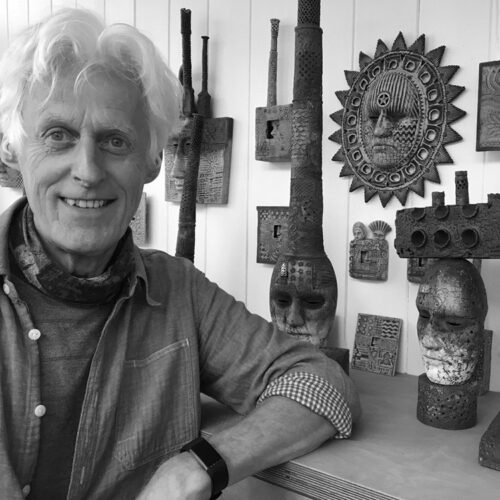
Alasdair Neil's ideas focus on the strange beauty found in the decaying architecture of industrial wastelands. He has built up a large collection of clay and plaster moulds that he has made from the surfaces of found fragments of discarded waste. It is these textures, patterns, shapes and colours that form the thread that runs throughout his entire range of unique hand built forms

Kate studied 3D Design at the University of Brighton. After graduating, she participated in an international ceramic residency in Japan where she worked alongside established Japanese, Korean, and American artists. On her return, Kate set up her ceramic studio in London where she worked for nearly ten years. She now works from her garden studio in Kent making raku and stoneware pieces.

Hilary's practice responds to observed details in the landscape with current focus on the geology and topography of the Suffolk coast, a place she has frequented for over 20 years; where the flat land meets big open skies and has a beguiling beauty all of its own. Erosion is a constant theme of this exposed coastline. The elements, battering, wearing, sculpting; imprinting the landscape over time and leaving their mark.

Since 2000 Owen Thorpe has been producing ‘families’ of pots using recurring themes and he has been making bowls and plates with inscriptions. All his work is made using a soft stoneware, high fired with occasional further enamel firings.

Jeremy trained in Falmouth, Cornwall and then in Cardiff before being invited to join Wobage Workshop in rural Herefordshire in 1995. From here, he makes wheel-thrown, wood-fired salt-glazed stoneware and porcelain. He and his wife Petra, also a potter and printmaker, live on the edge of the Forest of Dean. They were invited to join the Wobage studios as part-time apprentices to Mick and Sheila Casson, a role they maintained until Mick’s death in 2003.

Jo specialises in wheel-thrown porcelain and works from her studio in Hackney, East London. Her practice includes hand-making a fine porcelain design range, lighting and unique objects. Her individual approach to wheel-thrown ceramics, where high-fired porcelain often appears paradoxically to be fresh off the wheel, balances softness with rigidity, smoothness with weight and tactility.