


Contemporary Ceramics gallery and shop exhibits the greatest collectable names in British ceramics along with the most up and coming artists of today. Our distinguished makers are all carefully selected members of the Craft Potters Association.
All of our makers are members of the Craft Potters Association and each of them have a story to tell.

Jude undertook a foundation course at Somerset College of Art & Design, then gained a Dip. AD at Gloucester College of Art & Design in Fine Art (Sculpture with Painting). At art school, Jude worked mainly in bronze. She married John Jelfs in 1972 and became a potter. Jude and John live and work at the Cotswold Pottery, located in Bourton-on-the-Water, Gloucestershire, UK.

Suleyman Saba makes tableware and individual stoneware pots. The forms he makes and the glazes he uses bring together traditional techniques with modern sensibilities.

Agalis Manessi is a ceramic artist working from studios in London and Corfu, where she was born. After studying ceramics at the Central School of Art & Design, she was inspired by the teachings of Gordon Baldwin, Eileen Nisbett and Dan Arbeid who encouraged her enthusiasm for the plastic qualities of terracotta clay. After graduation she set up a studio in Hackney where she was a founding member of Broadway Ceramics and taught in further education. In 2018 she relocated her studio to Kennington in south London.

Bridget started making pots full-time while living in Scotland in 1976. At first, she made domestic stoneware, firing in a gas kiln and gained skills in all aspects of pottery. Having had no formal training Bridget’s determination and hard work meant she gradually developed her own technique.
She has always loved porcelain and gradually changed over to this material finding that it suited the style of work she was searching for. Eastern ceramics were very influential and she loved the Chinese and Korean shapes and glazes.

The passage of time and change observed in urban and rural landscapes has always been central to the themes Dennis explores in his work. The process of archaeology and its concern with time and layers has also greatly influenced the way in which he expresses his ideas. Architectural fragments, marks on the landscape, multi-layered and over painted surfaces, have all influenced the way he works in clay.
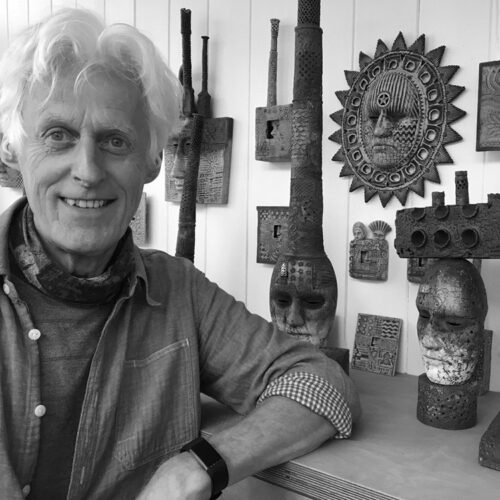
Alasdair Neil's ideas focus on the strange beauty found in the decaying architecture of industrial wastelands. He has built up a large collection of clay and plaster moulds that he has made from the surfaces of found fragments of discarded waste. It is these textures, patterns, shapes and colours that form the thread that runs throughout his entire range of unique hand built forms