


Contemporary Ceramics gallery and shop exhibits the greatest collectable names in British ceramics along with the most up and coming artists of today. Our distinguished makers are all carefully selected members of the Craft Potters Association.
All of our makers are members of the Craft Potters Association and each of them have a story to tell.

Hiro was born in Fukushima, Japan. Due to her father’s work commitments, Hiro had a peripatetic childhood. The constants in her life were her grandmother and being close to nature. However, she was dismayed later on to find that the traditional old buildings from her childhood walks with her grandmother had been demolished. Driven by sadness and nostalgia at the loss of her childhood environment/world in Japan, Hiro creates a link between the present and the past from her memories and imagination.

Sasha Wardell has been working in bone china since 1982. Her formal training in ceramics included both undergraduate and postgraduate degrees and industrial training secondments to L’Ecole Nationale des Arts Decoratifs, Limoges, France, and the Royal Doulton design studio, Stoke on Trent, UK.
An industrial approach to the traditional bone china manufacturing process has strongly influenced the way in which Sasha presently works, reflecting her fascination for methods and materials which present a challenge. It is for this reason that bone china, with all its idiosyncrasies, has remained her favourite material.

John completed a degree in ceramics at Harrow University in 2001 where he became intrigued by wood-fired ceramics and kiln building. He has since built several wood-fired kilns and has been exploring the unique colours, surfaces and effects which can only be achieved with this process.

Daniel obtained a BA (Ceramics) from Royal Melbourne Information Technology University (co-presented with Hong Kong Art School) in 2007.
Daniel creates carefully sculpted porcelain vessels. The start of Daniel’s creative process begins with throwing. He is fascinated by the patterns and ongoing variations that emerge during this stage. The unique traces left on the forms evoke for him a sense of a path paved with the sedimentation of memory.
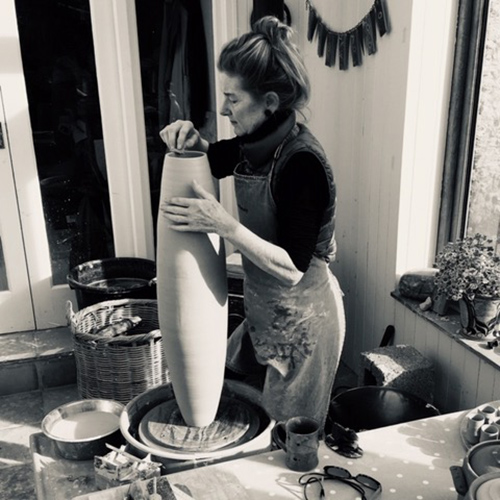
Many years ago, Harriet was inspired by an article by Dick Lehmann about carbon trap glazes. She has been exploring this intriguing glaze ever since. She believes that all the potters who work with carbon trap seek different qualities and achieve quite distinctive effects even though they may use the same recipe and fire to the same temperature in the same kind of kiln. The glaze is unusually responsive to the atmosphere in the kiln and even to the weather as it dries before firing.

Graham’s interest in ceramics began at York School of Art in the 1960s and continued at Cardiff College of Art, graduating from there in 1971. He later worked at both colleges as a ceramics technician and having retired in 2009, Graham established a workshop in Gloucestershire.