


Contemporary Ceramics gallery and shop exhibits the greatest collectable names in British ceramics along with the most up and coming artists of today. Our distinguished makers are all carefully selected members of the Craft Potters Association.
All of our makers are members of the Craft Potters Association and each of them have a story to tell.

Angela has been working in ceramics for over 50 years. Her first experience of clay was at after school class, leading to a Foundation Arts Course in Derby, then a BA in Wolverhampton, and an MA at Royal College of Art London. The latter two degree courses were very open-ended and encouraged exploration of other materials and a wide variety of working methods. This suited Angela as she has always been interested in both industrial production processes and sculptural techniques.

Paul studied studio ceramics under renowned ceramic sculptor, Mo Jupp at Harrow School of Art, graduating in 1977. Following a short period teaching in London, he relocated to Cornwall, where he established his pottery in 1979. He moved to his present home at Helland Bridge, where he works in a studio converted from an old chapel, in 1989.

Fiona’s focus is mainly on hand built ceramic vessels, with multiple layered surfaces. They combine traditional and contemporary processes. Pieces are first usually coiled or slab built, then painted and printed with coloured slips.

Duncan’s fascination with clay began as a child in his parents’ garden. The colour, smell and malleability of the earth led him to discover at school the transformation of clay by heat into a permanent object. As a teenager, Duncan was captivated by seeing his teacher throwing a pot on a kick-wheel, his bedroom posters were images of communist revolutionary heroes and 20th-century studio pottery.

Sue’s multidisciplinary conceptual practice comprises stand-alone pieces, installation, film and tableware, collectively defined by a distinct language. Current work is rooted in traditional techniques, thrown forms made on the wheel, firing in real flame kilns and using natural wood ash deposits and the reduction flame to add unpredictable embellishment.
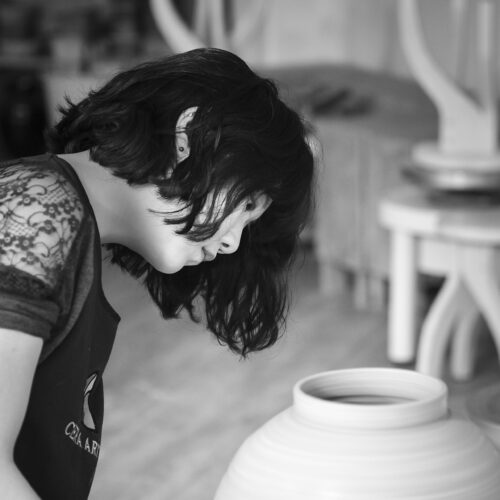
SaeRi strives to intertwine personal narrative with broader social and cultural influences, creating a visual representation of her experiences. Central to her artistic exploration is the profound impact of the "good child syndrome" that has shaped her identity since her youth. This complex, deeply rooted in societal and cultural expectations, has greatly influenced her journey as an artist.