
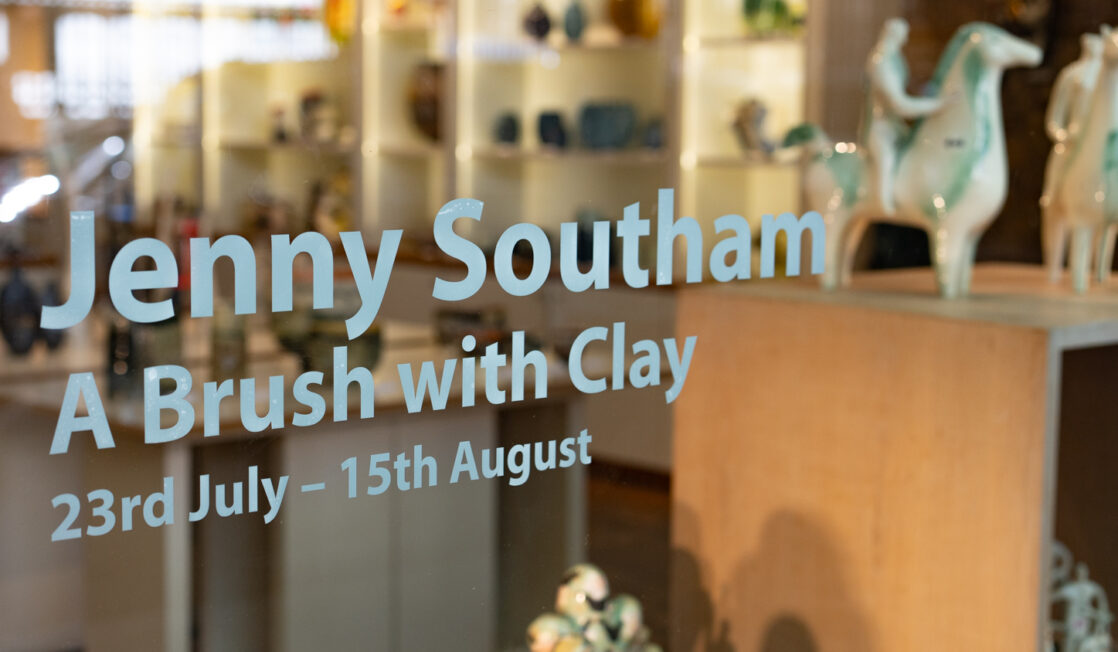
In this conversation, Jenny Southam discusses her practice in the context of her solo exhibition, A Brush With Clay at Contemporary Ceramics. She reflects on her working methods, sources of inspiration, and the ideas that underpin her work. The exhibition runs from the 23rd July – 15th August 2026.
Is there a typical working day?
Contemporary Ceramics: Describe your studio on a typical working day – what does it look, feel, even smell like to be in that space?
Jenny Southam: For several years I shared local community artist studios in Exeter, which was like being back in Art School, with plenty of social interaction, but with more administration. Now I have a studio at the end of the garden, and so there are no commuting issues, and I have more autonomy within my own created space.
At the back of the studio there is a deep railway cutting. This acts as a wildlife corridor and habitat for a very large variety of birds, foxes, badgers, bats and insects. I have binoculars handy so that I can check out a bird, or to watch a young fox sleeping in the sun.
I have two kilns in there; a large and a small one, and a large amount of shelving units to accommodate my work and materials. I don’t have a pin-up board but use the metal of these units and magnets to pin images, postcards and vintage knitting patterns. The eye can rest upon them in between activities. I am aware of the passage of the sun moving behind me throughout the course of the day, which subtly alters the look of what I am currently working on.
Contemporary Ceramics: Was there a moment – early on or later in life – when clay stopped being a material and started feeling like a language?
Jenny Southam: When growing up I was never happier than when I was drawing, painting, or making things out of a variety of different media. We had what we called ‘The Clay Patch’ at the very back of our garden, which was an old chalk quarry filled in with local Cambridge clay. My brother and I used to dig it out and make animals or human figures with the clay, or include it as a material in our childhood games.
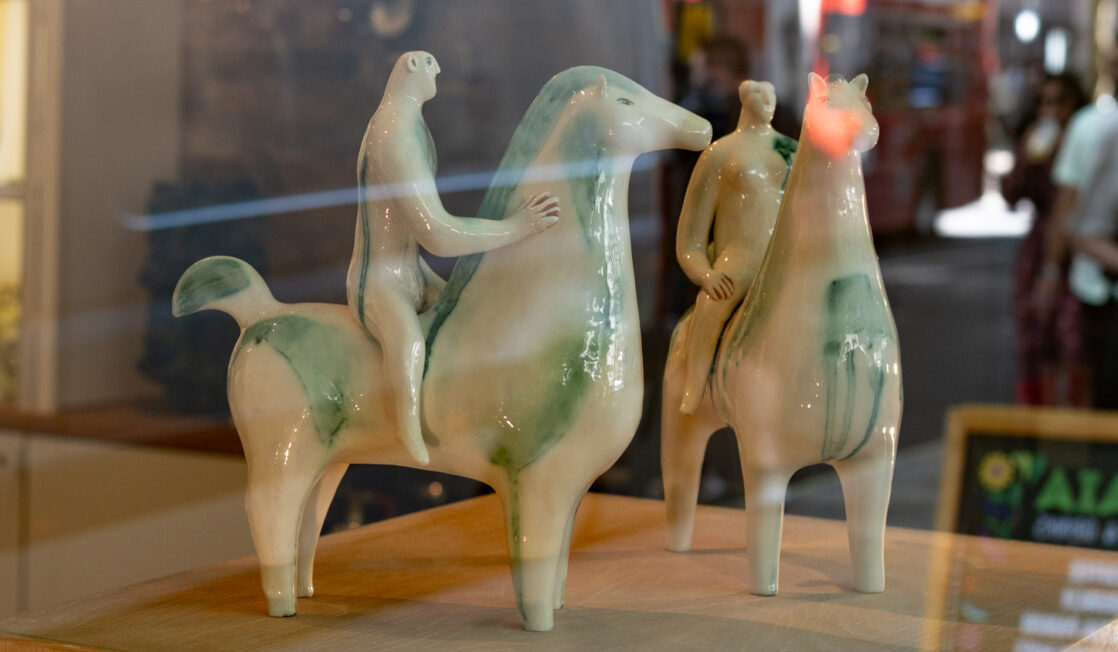
And so the conversation has always been there, in the background, as a language to be used in everyday activities. There was quite a long period of time when I also used other materials for sculpture while at Art School in Bristol. Then clay was only as a means to an end in the construction of moulds for casting work in other media.
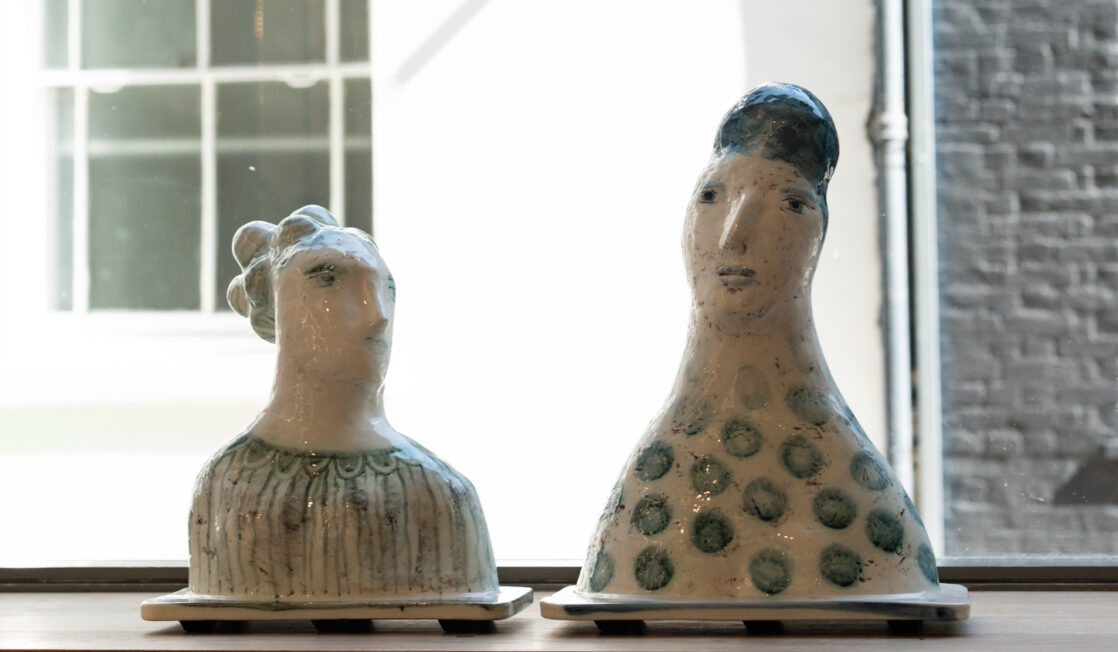
I feel very fortunate to have found clay. As a sculptor I feel part of a very long and ancient lineage of humans who handled clay, who have been pushing it around to see what this plastic material is capable of, and am aware of how the imagination is integrally part of this conversation with clay and hands. In addition to the form, the decoration and surface texture are closely bound to this creative process. I revel in this close connection between form and surface.
Contemporary Ceramics: What was the first piece of art that truly stopped you in your tracks? Do you think it still lives somewhere in your work?
Jenny Southam: I mostly grew up in Cambridge, and to have all the university museums of archaeology and anthropology, classical archaeology, zoology, earth sciences, folklore, as well as Kettle’s Yard and the Fitzwilliam Museum, freely available to visit was a rich experience. One I’m sure I took for granted at the time.
The Fitzwilliam was a favourite as it displays a diverse range of artefacts, from cylinder seal rings to modern paintings, from battle armour to delicate Meissen figurines. All the ancient figurines and animals made out of clay, Egyptian faience, bronze and jade fascinated me. The painting that made the largest and most grisly impression upon me in the Fitzwilliam was ‘L’Umana Fragilità’ (Human Frailty) by the Italian painter Salvator Rosa, painted in 1656. Here a huge winged skeleton emerges from a thick nocturnal gloomy background and guides the hand of the child who is sitting on his mother’s lap to write ‘Conception is a sin, Birth is pain, Life is toil, Death a necessity’. In 1655 a devastating plague hit Naples, and many of Salvator Rosa’s relatives perished in it, including his son. This was Rosa’s response to his massive grief. As a child, I found these narratives compelling and powerful, and I feel that I continue to respond to the transportive qualities of narrative, both within my work and that of others.
Contemporary Ceramics:You began your sculptural practice in bronze before moving to clay – how did that shift change the way you work, and what did clay offer that bronze couldn’t?
Jenny Southam: I stopped working in bronze when I moved from Bristol to Exeter when we bought our first house here. I no longer had immediate access to bronze casting facilities, and it was impractical to try and install any of the gear needed to build a foundry in a small urban Victorian terraced house with a pocket handkerchief garden.
I began to cast around for alternative materials, and after some experiments clay seemed to be the obvious choice. I feel that the main difference between the two is that bronze casting is very process-led. There are so very many stages that go into the production of a piece of work, including the making of moulds, foundry work, extensive fettling and cleaning towards the end. Sculpting in clay is refreshingly immediate, and much more straightforward. I could make pieces in less time, with less expense and mess, and get to see the results so much quicker. Therefore, ideas would flow faster and more ground could be covered.
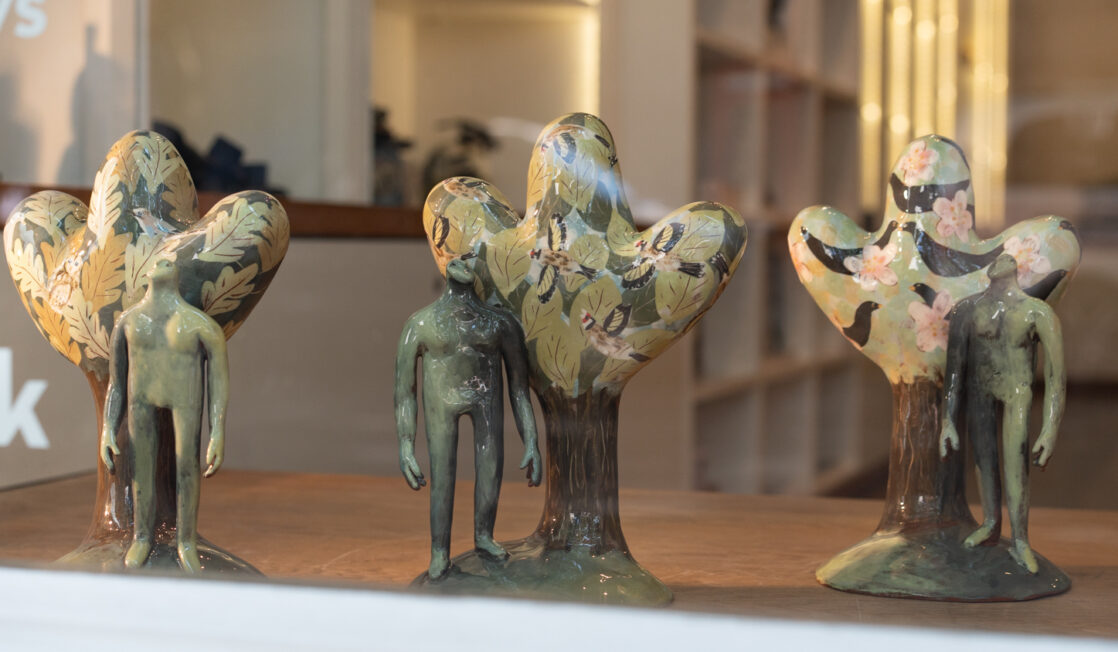
The other difference is that of surface decoration. Again, with clay, the slips, stains and oxides that I use are considerably more immediate than the patination that bronze requires, and the colours are more varied. I have not ruled out the idea of returning to the medium of bronze at some stage though, and still deeply admire its characteristics.

Contemporary Ceramics: Your figures are often caught in a moment of dramatic juxtaposition – frozen in a critical instant. How do you arrive at those moments, and how do you know when a composition is right?
Jenny Southam:
I sometimes use sketchbooks, and I sometimes work directly in the clay without any feeling of need to carry out any drawing. It depends on what I’m working on at the time.
I have a body of work entitled ‘Knitting Pattern Folk’ whose inspiration came from my collection of vintage British knitting patterns, mainly from the 1960s/70s. Many of the pictures illustrating the patterns have one or more models, a background, props, presented as a narrative. I respond to these delightful images and like to interpret the somewhat theatrical tableaux into clay, but I usually loosen up by making paintings and collages based on the scene first. This allows me to generate ideas and often takes me to surprising places. I will then work up a possible composition with drawings before starting to interpret it into clay. When working on the clay I will allow the handling and the building help lead the direction, so that the end piece is not prescribed from the start. Making small maquettes prior to embarking on a larger piece is also always useful.
Knowing when a piece is just right is the perennial problem for any creative person, and it is just trial and error and being sensitive and tuned in to your feelings and reactions along the journey. The ‘critical instant’ that you mention is an interesting one. It comes back to the emotional narrative of a piece again; the telling of a story in terms of gesture, stance and application and manner of decoration.
Contemporary Ceramics: Slip decoration is an important element of your sculptures – applied, you’ve said, to enhance the emotional resonance of the work. How does that process develop, and how closely is it tied to the making of the piece itself?
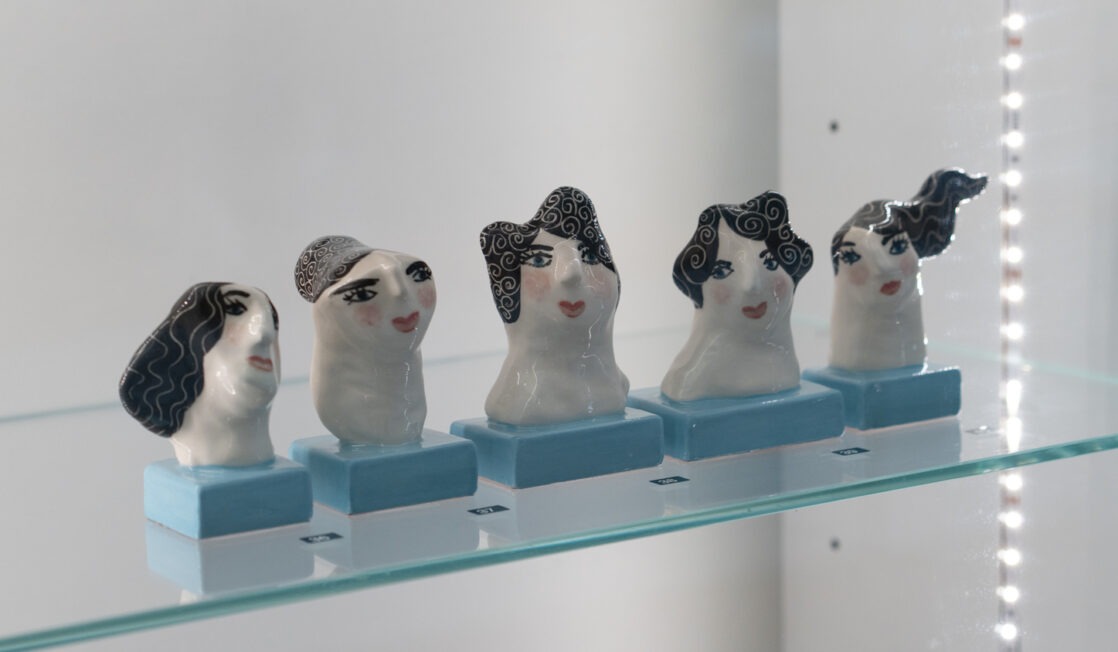
Jenny Southam: When I begin a series of works, I have a set of ideas about the nature of the forms I wish to make, and also a broad understanding of the approaches of decoration that I wish to explore. As a piece of work is being made it will start to manifest its own persona or mood, either by accident or design.
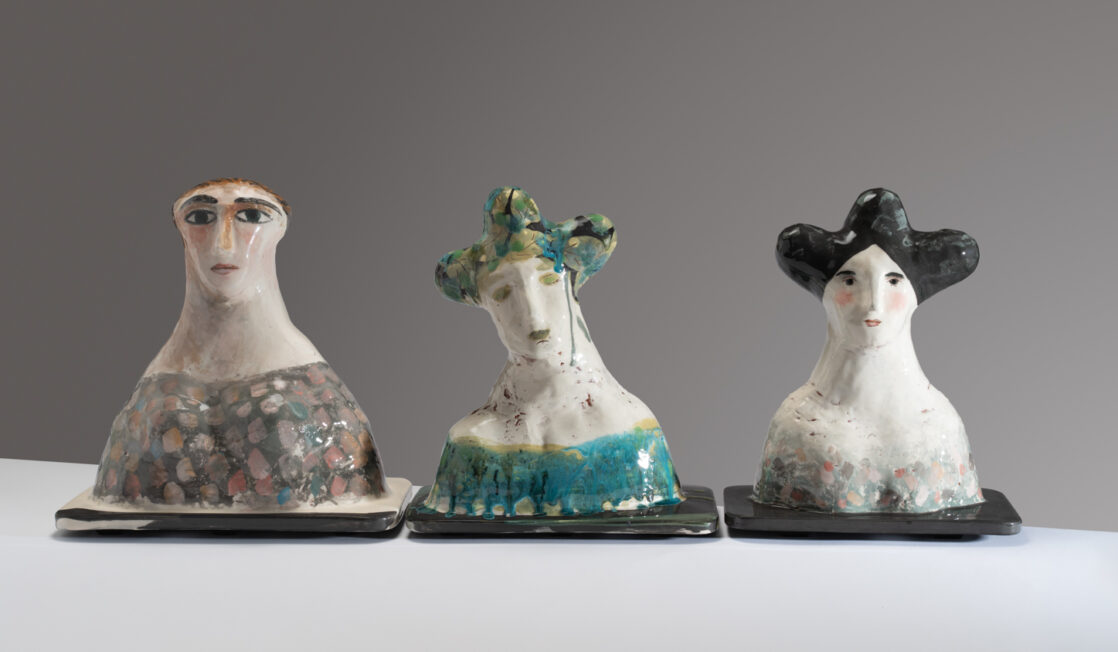
I aim to echo these characters with the colours I use, and in the physical way in which I apply the colours. This might be in a particularly gestural manner or perhaps in a more restrained way.
Contemporary Ceramics: When you began working towards A Brush with Clay, did you have a clear sense of what you wanted the exhibition to be – or did the work lead you there?
Jenny Southam: A bit of both. I had a broad vision about the range of works that I wanted to have the opportunity to explore further. And then there were surprises that arose during the making as I felt my way through the long journey of making it all.
Contemporary Ceramics: Looking at the work in this exhibition, what has surprised you most about where the work has taken you?
Jenny Southam: When I first viewed all the work displayed in the gallery, I was somewhat taken aback by the fact that over a year’s worth of continuous applied effort was all too easily swallowed up by the space there. It brought home to me once again just how much time and investment of care goes into each single piece I make.
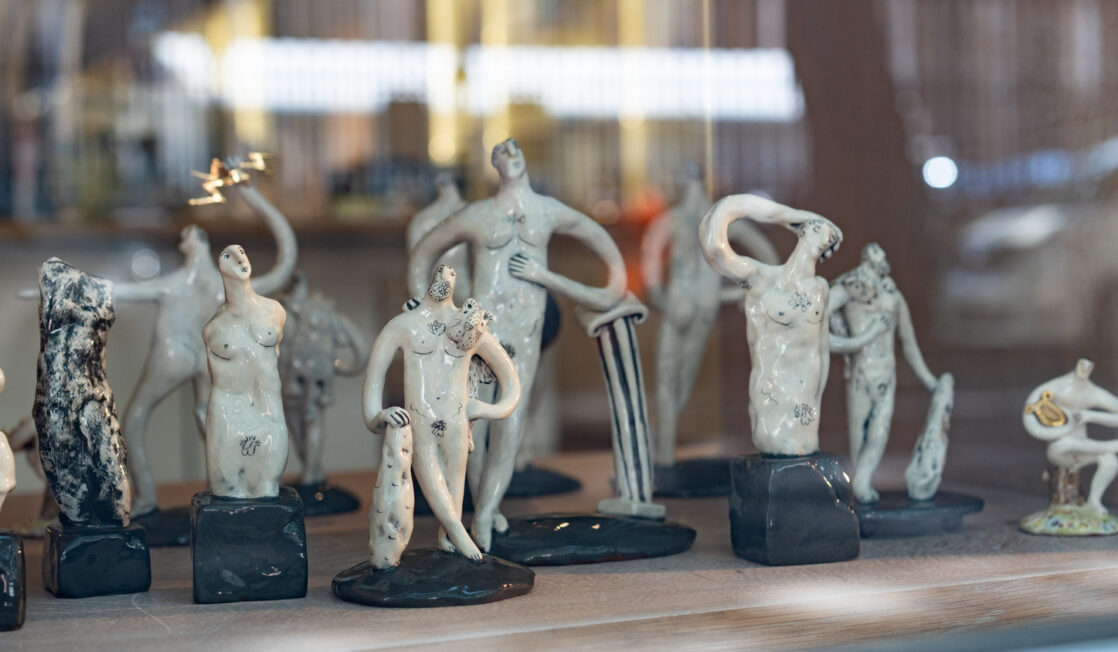
Nothing can be rushed, although there is nothing like the pressure of an exhibition looming to help keep the eye on the ball.
I sculpt in small themed bodies of work, which can seem to be quite diverse and varied. But stepping back and looking at the whole collection, there are themes and strands running throughout it. I am currently taking stock of how I feel about this body of work as I have been living cheek by jowl with these pieces for a while. I feel that I need a bit of space from them, for a bit of time to evaluate my opinion.
I am however excited to use it as a place for jumping off into directions unknown in the future. I know that I would like to continue to move towards a more painterly surface approach and a freer and more gestural use of the brush.
Contemporary Ceramics: And finally, what do you hope someone feels standing in front of one of your pieces – not thinks, but feels?
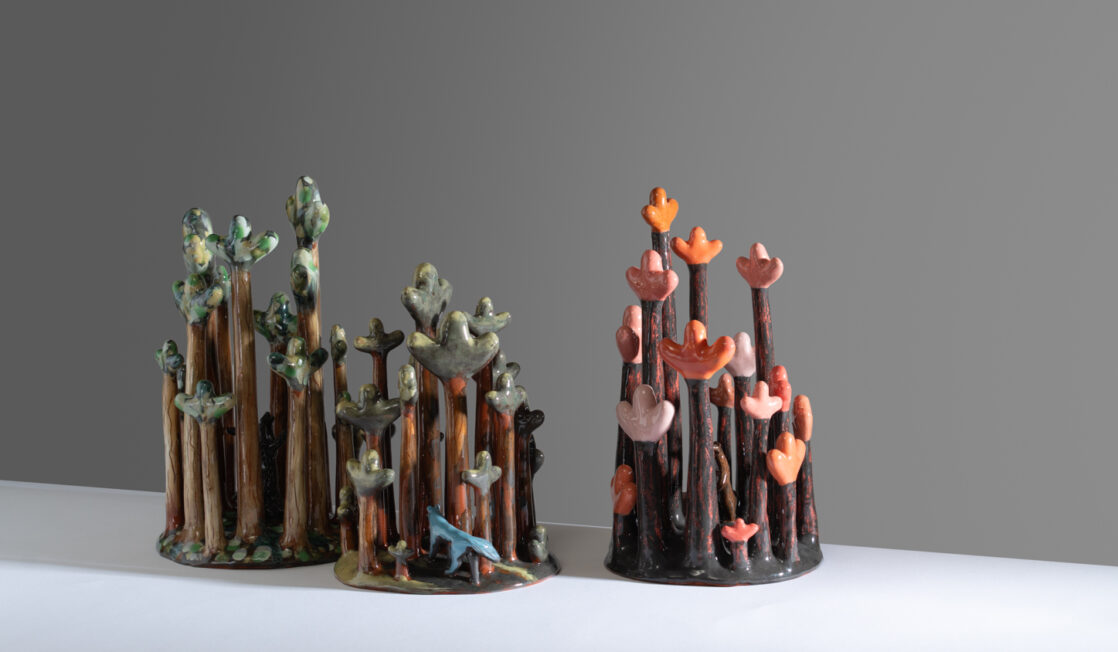
Jenny Southam: I find that if I stand in front of a particularly moving artwork, it inspires me to want to pick up a brush, or take up tools in order to explore the creative urge that it invariably brings out in me; a wish to create something beautiful in the way that the art work I am looking at is beautiful.
This happens because it carries transportive qualities, which can often not be put into words, but works on a deeply emotional and mental level.
This is what I would wish a viewer to feel when engaging with one of my ceramics. I would like them to relate to it on some deep level, to be moved, and to be transported.


