In this conversation, Sophie MacCarthy discusses her practice in the context of her solo exhibition, Accidental Compositions at Contemporary Ceramics. She reflects on her working methods, sources of inspiration, and the ideas that underpin her work. The exhibition runs from the 20th August – 12th September 2026.
Is there a typical working day?
Contemporary Ceramics: Describe your studio on a typical working day – what does it look, feel, even smell like to be in that space?
Sophie MacCarthy: My studio is at the Chocolate Factory Studios in Stoke Newington, a great community of artists; painters, potters and creatives. I’ve been there nearly 30 years now. My studio is a large space but I share with 2 others, Michael a fellow potter and Catherine a mixed media artist, and whilst I have the larger share of the space I’m always frustrated by the lack of it!

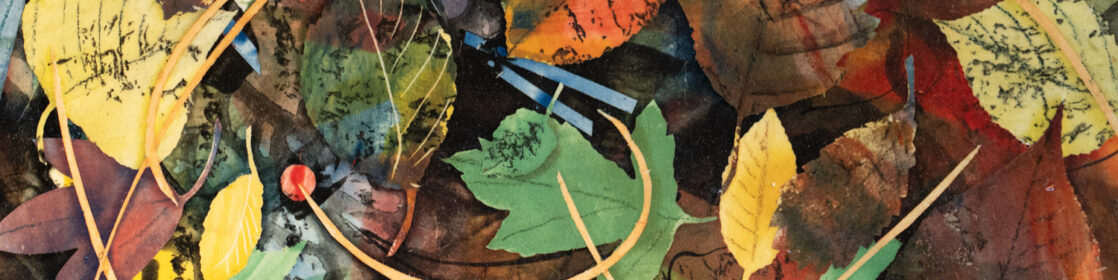
I have a large, very long table which, at the top end, accommodates all my decorating paraphernalia, slips and brushes and colour stains & oxides. The rest of the table is strewn with countless sheets of tracing paper with all my leaf tracings accumulated over years, and this is where I do all my cut-outs.
I have a throwing/making area with benches and racks and all my green ware and finished dry work is stored here.
Whether I’m on my own in the studio or with my co-sharers there’s always music. Either Radio 3 or CDs of jazz: Oscar Peterson, Bill Evans or classical: mostly Bach. Or pop: Steely Dan, Kate Bush. There’s a huge CD collection and fortunately we have like-minded tastes!
So in the mornings when I get in, the studio gently grooves to the sound of music and the smell of freshly made coffee. It’s a good start to a long day of making and decorating.
Contemporary Ceramics: Was there a moment – early on or later in life – when clay stopped being a material and started feeling like a language?
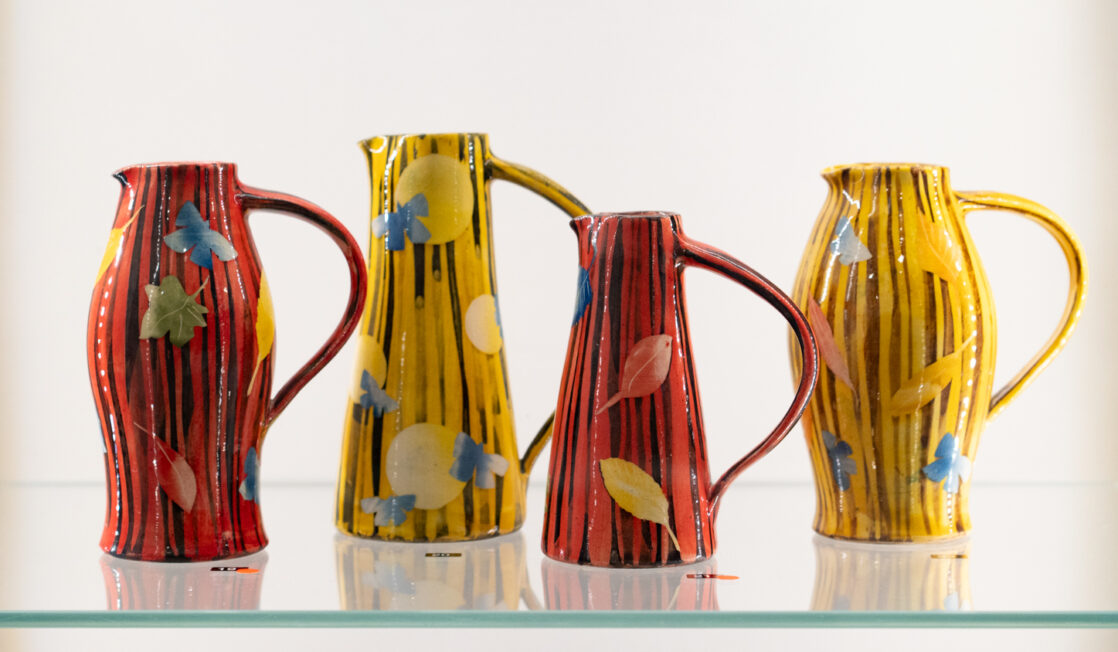
Sophie MacCarthy: When I discovered colour and decoration in the mid 1980s, it became an expressive language for me. There seemed to be an ever increasing vocabulary as I experimented with slips, stencils and wax resist, exploring themes and playing with imagery.


Contemporary Ceramics: What was the first piece of art that truly stopped you in your tracks? Do you think it still lives somewhere in your work?
Sophie MacCarthy: When I first encountered Elizabeth Fritsch’s work. I was mesmerised by her intricate, trompe-l’oeil painted patterns and the fine lines, grids, and colour blocks that suggest movement, depth, and musical rhythm across the clay surface. This resonated with me at some deep level.
Also the abstract landscape paintings of Ivon Hitchens with his use of broad, fluid brushstrokes to evoke the slow unfolding of space, light, and atmosphere. There was something about his distillation of trees, water, and undergrowth into interlocking patches of muted greens, blues, and earth tones, punctuated by brighter accents that also spoke to me, and in fact during a residency in East Sussex in 1992 I found myself responding to and being inspired by the landscape of the rolling South Downs, by abstracting it and painting with slips in a looser more gestural way.
Contemporary Ceramics: Your technique of painting coloured slips directly onto dry clay has been developed over the last 35 years. Can you tell us more about how that process works, and why you are drawn to the immediacy of slip on dry clay?
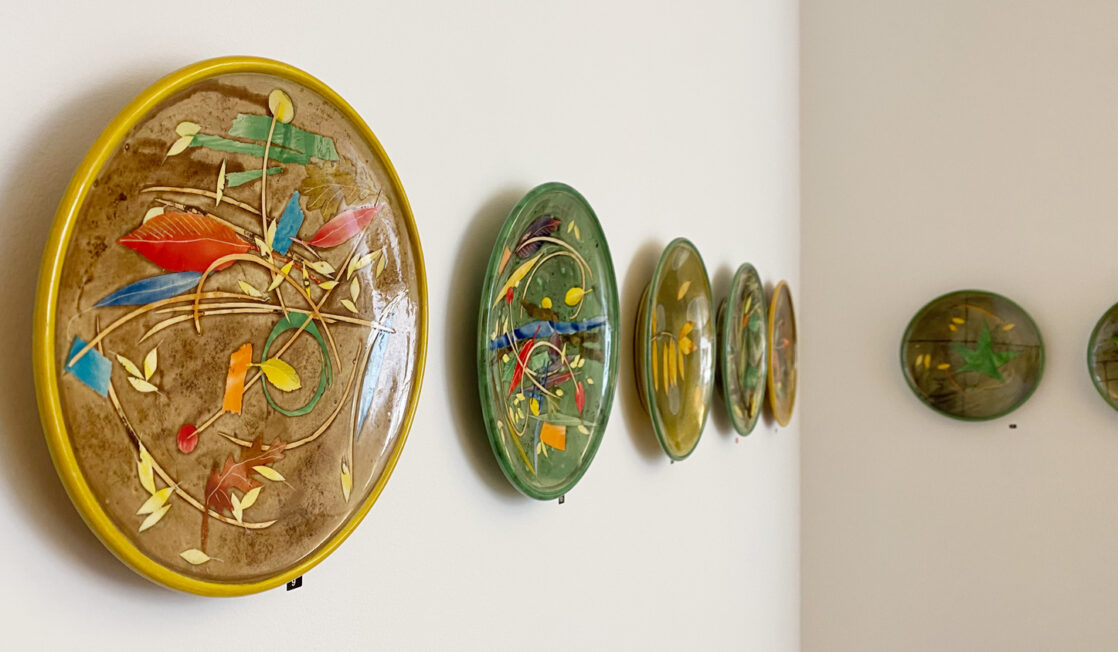
Sophie MacCarthy: Thin or thin-ish slip painted on to dry clay is absorbed quickly and allows me to overlap with other colours to broaden the colour range and create tonal depth.

I have taken things to an even higher more dangerous level recently by pouring very thin, almost watery, strongly coloured slip over things. It is risky, the action has to be quick, but for me, the subtle effects this produces is a pleasing alternative to the more vibrant, multi-coloured tones of most of my work.
Contemporary Ceramics: Alongside the slip painting you use stencils, wax resist, sgraffito, sponging and paper cuts. How do you decide which techniques to use for a particular piece, and do they tend to work in a set sequence or does that vary?
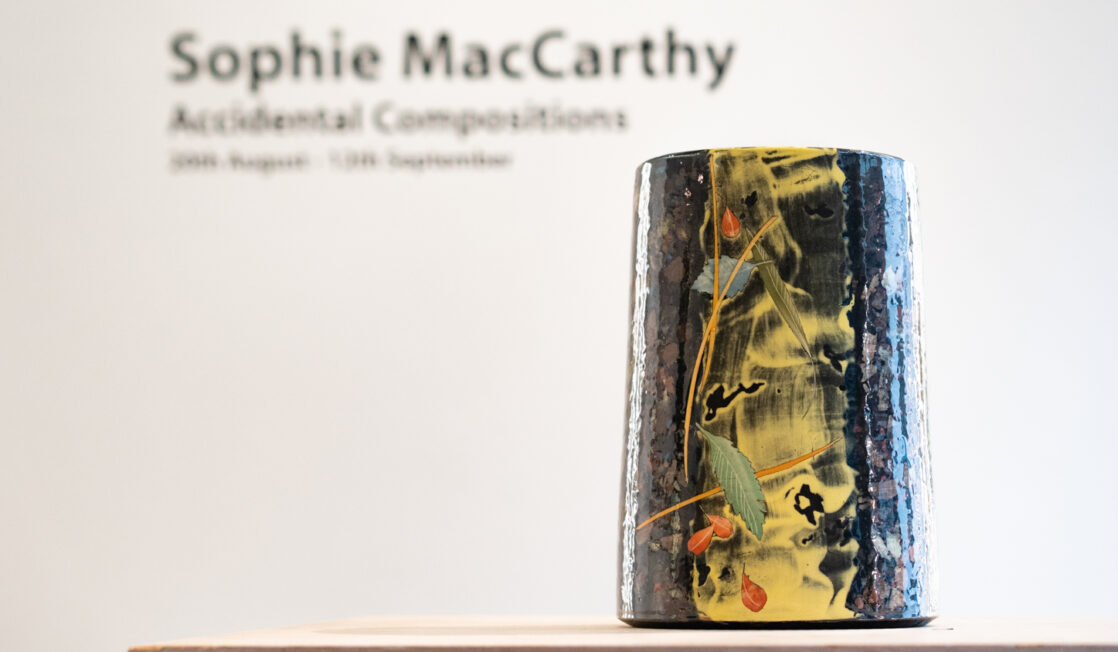
Sophie MacCarthy: For many years I did an olives and leaves design which was entirely done with wax resist. Now I work predominantly with stencils and paper cuts but quite often I will use wax resist either with a natural sponge, sparingly for effect.
If I am trying to evoke the texture and colours in tarmac, I will use repeated small brush strokes in wax, built up over many layers of coloured slips. Dark black is also sponged very sparingly. All these specific elements of decoration are applied entirely instinctively. As I feel it.
Contemporary Ceramics: You describe being drawn to random scatterings: leaves blown against a kerbside, fish caught mid-movement, birds reduced to silhouette. How does that moment of observation find its way into your work? Do you sketch, work from memory, or go straight to the clay?
Sophie MacCarthy: When I’m out and about I am often looking at the ground and I do take photos. They are an ‘aide-memoire’ for me and inspire my compositions.
I have thousands of leaf tracings but I am easily seduced by yet more stunners that I might come across on the ground or on a drain grid, on tarmac or floating in a puddle.

Images: Sophie MacCarthy

Contemporary Ceramics: When you began working towards Accidental Compositions did you have a clear sense of what you wanted the exhibition to be – or did the work lead you there?
Sophie MacCarthy: I didn’t have a clear idea, I only knew I had to make lots and lots of pots! Hopefully a good and balanced selection by the end. But it took a while to get going and I did suffer from potter’s block quite a lot but when things finally started to come out of the kiln that were pleasing, it spurred me on to new things and it energised me. Of course by the time the deadline was upon me I could have done with another month!
Contemporary Ceramics: Looking at the work in this exhibition, what has surprised you most about where the work has taken you?
Sophie MacCarthy: The curation of this exhibition has been exceptional. The work has been displayed so beautifully, with sensitivity and a keen eye for groupings and colour juxtapositions that look just right.
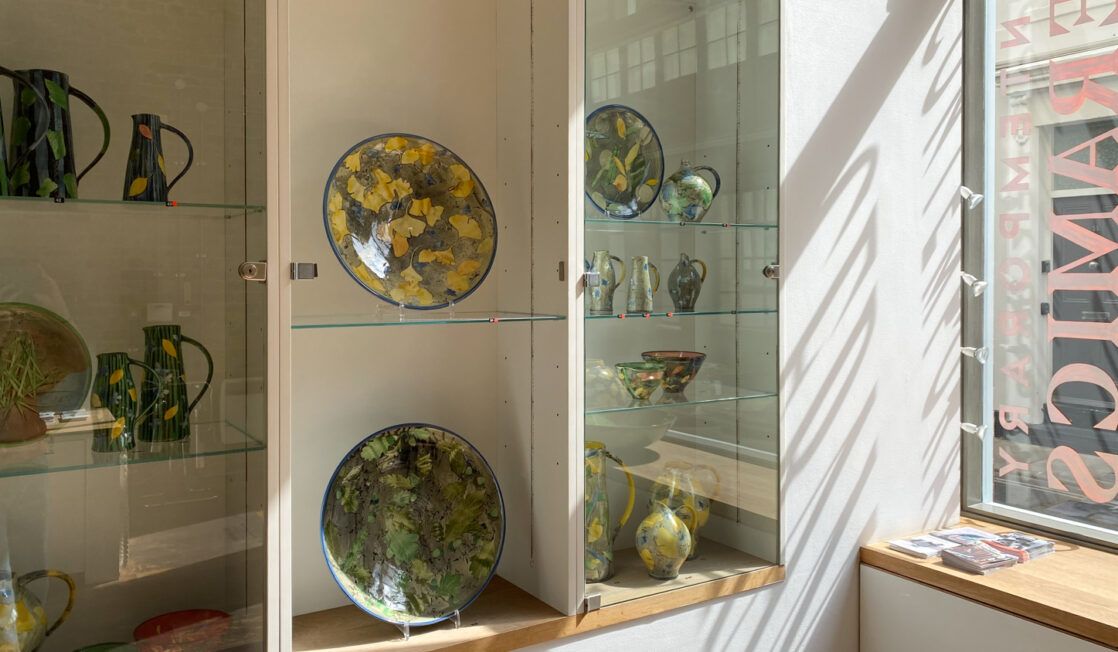
When I had all the pieces accumulating in my studio, stacking up and crammed on to shelves, I wasn’t feeling too confident that they would make a good exhibition, but when I saw the display for the first time, it opened my eyes as to how much I had thought about colour and pairings and groupings and of course size – from very small to HUGE.
These things were all brought out and made to shine thanks to the brilliant CC team!
Contemporary Ceramics: And finally, what do you hope someone feels standing in front of one of your pieces – not thinks, but feels?
Sophie MacCarthy: I would hope that my ceramics produce a smile rather than a frown. People have told me that my pots are joyful and I’m glad of that.